Cassiopeia Newsletter – Winter solstice 2016

Updated: Aug 22, 2025

Date: December 20, 2016
In this Issue:
Message from the president
Please don’t be a DOOFAAS
EPO Reporting Tool
EPO Update from the Department of Physics and Astronomy, York University
CRAQ Summer School: Exoplanet Atmospheres
BRITE-Constellation News
Canadian Gemini News
Update from the Canadian Space Agency (CSA)
Maunakea Spectroscopic Explorer (MSE) Update
Nouvelles du CNRC Herzberg / NRC Herzberg News
Editor: Magdalen Normandeau & Joanne Rosvick
Cassiopeia is CASCA’s quarterly Newsletter, published on or near the solstices and equinoxes (March 21, June 21, September 21 and December 21).
To submit a contribution please email cassiopeia.editors@gmail.com. All submissions must be received by the due date (usually 2 weeks in advance of publication) to be published in the next edition. I accept plain text and Word documents. Note that the formatting of your document will not be preserved. Please include any images as attachments in your email, not embedded in the text. Please include URLs in parentheses next to the word or phrase that you wish to act as link anchors.
Word from the president
By Bob Abraham, CASCA president (Cassiopeia – Winter 2016)

Dear CASCA Members,
The last six months have been eventful ones for our association. The federal government has solicited feedback from Canadians on a number of matters of relevance to our community, and CASCA and its Coalition for Canadian Astronomy partners have responded by providing written input to Canada’s Innovation Agenda, and to the federal government’s Fundamental Science Review Panel (whom I also met with in Calgary). We also provided input to the government via the pre-budget submission process, mailed out a summary of the conclusions of the CASCA Mid-Term Review to all MPs, and are about to send each MP a beautifully printed copy of the full review (the production of which has been overseen by Rob Thacker, who has an eye for these things). We have made it a priority to learn more about the aspirations of our industry partners, particularly in the Space Astronomy sector, and reached out to the Aerospace Industry Association of Canada to consider ways in which CASCA could partner with them on topics of mutual interest. Many of you also participated in the Canadian Space Agency’s Space Exploration Workshop, in which CASCA members played a prominent role, and which ended on an optimistic note regarding the future of Canada’s aspirations in space astronomy.
In spite of this good progress, the elephant in the room remains the Thirty Meter Telescope project, which is facing some real challenges in Hawaii. As most of you know, the crux of the matter is the decision made almost exactly one year ago by the State Supreme Court of Hawaii to invalidate the TMT’s building permit (because due process was not followed in approving the initial permit). A contested case hearing is currently underway to determine if a new permit will be issued. The project must await the outcome from this (and the inevitable appeals, should the decision be positive), so I think it will be about six months before we know whether construction can continue at the Maunakea site.
The uncertainty over the future of astronomy on Maunakea has forced the TMT project to look seriously into alternative sites (more on this below). At a more personal level, it has also spurred many of us to reflect more on issues regarding Native Hawaiian culture and sovereignty. I personally think this is bit of a silver lining, as many astronomers now have a deeper respect for, and understanding of, the issues in Hawaii. Within CASCA, this has also led to some soul-searching about what we might be able to do to connect more closely with our own aboriginal community.
This culminated recently in the CASCA Board’s Decision to reinvigorate the Westar Lectureship series, and to operate the Westar lectures in tandem with teacher training seminars offered by the CASCA-sponsored Discover The Universe Program.
The overarching goal of the revitalized Westar Lectureship program is to connect the exciting developments in astronomy more closely with the general public in under-served areas of the country, with a special eye toward engaging Aboriginal Canadians whenever we can. We hope to delight people with the spectacular progress being made in our subject, fill them with pride in the fact that so much of this progress is driven by Canadians, and ignite an interest in STEM-related subjects. The first Westar Lectureship in the new series occurred last month in Ayamdigut (Whitehorse). By all accounts it was a tremendous success, and CASCA offers its congratulations to Westar Lecturer Dr. Christa Van Laerhoven, University of Toronto graduate students Jielai Zhang and Heidi White (who organized the teacher training seminar), and Julie Boldoc-Duval, who coordinated much of the activity as part of the Dunlap/CASCA Discover the Universe program. The Westar Lectureship has had a great start, and we very much hope that many CASCA members will step-up and volunteer to be Westar Lecturers in the future.
Returning now to TMT, it’s clear that the situation is serious, though how serious will only be known once the legal situation in Hawaii becomes clearer. In the meantime, the project is focusing on learning more about the properties of an alternative site on La Palma in the Canary Islands (see Anecdote 1 below). CASCA organized a ‘tiger team’ committee to look at the qualities of several alternative sites. This committee did a great job, looking carefully at a lot of data in a short time, and we owe them our thanks. The conclusions have been summarized in a mailing sent to the CASCA exploder, and it’s fair to say that the lower altitude of La Palma is a source of concern to those astronomers who see their ground-based future as heavily weighted toward activity in the mid-infrared. On the other hand, it looks like building on La Palma may result in significant cost savings, which may make the project much more affordable (an important factor, as the delay in construction is costing money, leaving the project short of funds).
If you’ve read this far and have concluded that a lot is going on while we wait for the legal situation in Hawaii to untangle itself: you’re right. Don’t even get me started on things like the fallout from the shuffling of Canadian members on the TMT board of directors. I think a lot of this gets down to the understandable fact that impassioned and smart people who have given years of their lives to the TMT project find it incredibly frustrating to be stuck playing the waiting game. I’ve spoken to most of the principals in the international partnership, consulted with all the relevant CASCA committees, and spoken to many of you personally about TMT, and it’s clear that there is a huge range of views on how best to handle the uncertainty while we await the convergence of the legal process in Hawaii. However, one thing that everybody in Canada that I’ve spoken to agrees on is the importance of operating within the framework of the Long Range Plan (LRP). The LRP gives us a degree of coherence that other disciplines envy, and this coherence has led to much of our success (which is bibliometrically analyzed in excruciating detail in… the Long Range Plan).
Nobody who helped put the LRP together figured we live in a Universe where large technical projects come together with anything like perfect smoothness. Essentially all big science projects face technical and/or financial challenges. A perfect example that is close to home is the James Webb Space Telescope. I returned from the Advisory Committee meeting for this a few weeks ago and can assure you the project looks to be in great shape. But talk to me sometime about its near-death experience five years ago, which was far more serious than what TMT is facing now. More often than not, these big projects face multiple crises. Seeing them through to successful conclusions takes planning, flexibility and grit. Scientists who have been through this before ‘get’ this, and fortunately our government sponsors get it too. Challenges are to be expected, but keeping our heads in the sand helps nobody, so we need to have a system in place for both keeping an eye on things and devising ways to navigate the way forward when things get tricky. In our community, this is handled by the Long-Range Plan Implementation Committee (LRPIC). The LRPIC is an important part of our system, and of course the LRPIC is keeping a close eye on TMT right now.
Monitoring progress (and being prepared to undertake course corrections) will be important to the ultimate success of TMT, but it’s also crucially important for the community to have a clear sense for what is going on. Up until recently, informing the community about what has been going on with the TMT project has been handled informally (via various private mailing lists) but that’s just not the right way to communicate progress on such an important project with so many stakeholders (academic, industrial, and government). So I’m pleased to be able to report that CASCA and ACURA are working together to form a Canadian TMT Advisory Committee which will have two big roles: (1) It will continuously assess progress, making sure TMT meets the scientific, technical and strategic goals set out in the Long-range Plan, and it will feed this information to the LRPIC; (2) It will act as a conduit for consulting with and informing the community about the state of the TMT project, via regular updates and Webex ‘town hall’ style meetings. The composition of the Canadian TMT Advisory Committee is coming together as I write this and I think it’s going to be an important committee. If you’re asked to serve on it, please say yes. In any case, I think we all share the hope that this committee will keep the CASCA membership so well informed that I won’t find it necessary to write such a long-winded President’s Message in the future!
With best wishes for the holidays and for a wonderful 2017,
Roberto Abraham
Anecdote 1: I confess that I love La Palma. I obtained the data for my PhD from the (newly-commissioned) William Herschel Telescope there back when dinosaurs roamed the earth. This first-year grad student came back from his first observing run with a tape full of 0.7 arcsec FWHM images of BL Lac host galaxies, several bottles of duty-free Rioja, a tan, a huge head start on a thesis, and a big smile.
Please don’t be a DOOFAAS!
By Pauline Barmby (Cassiopeia – Winter 2016)
If you haven’t seen the Dumb Or Overly Forced Astronomical Acronyms Site (or DOOFAAS) produced by Canadian astronomer Glen Petitpas, go have a look. It’s pretty hilarious. It doesn’t yet list “H0 Lenses in COSMOGRAIL’s Wellspring” (H0LiCOW), which, I have to say, still makes me scratch my head.
In astronomy we like to make up names for our projects, be they instruments, telescopes, surveys, or programs. Often these are clever or silly; usually they are more memorable than the standard space agency three-letter acronym. It’s a way to make a project more fun and to perhaps get it a little more attention when colleagues first hear about it.
It’s possible to go too far with being clever, however. One person’s slightly risqué or edgy name can make others uncomfortable and send the signal that our field is unwelcoming. A well-known example is Source Extractor, a heavily-used astronomy software package that has littered hard drives with “.sex” files for decades[1]. There are other, more recent examples that I won’t dignify by mentioning.
The CASCA meeting Code of Conduct specifically notes that “All communication should be appropriate for a professional audience including people of many different backgrounds. Sexual language and imagery is not appropriate.” Other conferences have similar codes. So if you give your project a racy name, the organizers could (and should!) ask you not to mention it by name. This is probably not what you want.
The next time you make up a project acronym, think about the consequences. What messages does it send? Could you talk to a group of 12-year-olds about it without them giggling? How about your university president? When the committee assessing your next job application finds the project name in a Tweet or a Facebook post, what will they think about your character? There are plenty of ways to be creative without being exclusionary, so that people smile rather than grimace when they hear about your project. Please don’t be a DOOFAAS.
[1] Did you know that the configuration files for this program can have any extension? I call mine .cfg.
EPO Reporting Tool
By Phil Langill (Cassiopeia – Winter 2016)
The CASCA-EPO committee would like to remind everyone to please submit via the new reporting tool some simple data about your outreach efforts in 2016. The form is here:
and is very simple to use. Of course the more detailed your info the better, but if your time is short please just enter the total number of people you reached this year and a line or two describing what you did.
Thank you very much for your assistance, and for your time and energy engaging Canadians in astronomy and science in 2016!

EPO Update from Department of Physics and Astronomy, York University
By Michael De Robertis and Richard Bloch1
(Cassiopeia – Winter 2016)
Astronomers at York University occupy the north hallway of the third floor of the Petrie Science and Engineering Building (named, like the CASCA Prize Lecture, after the noted Canadian astronomer, Robert M. Petrie). Not only does our floor include classrooms used by students from a variety of science and non-science courses, but it also contains the main entrance to the York Observatory that houses 40 cm and 60 cm telescopes in two separate domes, and which regularly hosts public viewing sessions throughout the year, serving thousands of people.
It is in this setting that astronomers have recently established two education and public outreach (EPO) initiatives that are the subject of this update; a series of posters down the main astronomy hallway, and video content for our new Astronomy Education Station (AES) situated in the NW corner of our hallway.
Though the Department of Physics and Astronomy has seven astronomers (though only six at the time these initiatives took shape), our research interests span the four major areas of modern astronomy: Planets, Stars, Galaxies, and Cosmology.
The first of our EPO initiatives involved the creation of posters concentrated on these areas. (In fact, we divided each of the first three areas in two because of the richness of these topics.)

Individual posters focused on the following areas (facilitated by York faculty members):
Solar System (John Moores; Planetary Scientist with the Lassonde School of Engineering)
Extra-solar Systems (Paul Delaney)
Star Life (birth and mid-life) (Michael De Robertis)
Star Death (Norbert Bartel)
Galaxies and Clusters (Marshall McCall)
Active Galactic Nuclei (Patrick Hall)
Cosmology (Matthew Johnson)
The faculty coordinator Michael De Robertis, and senior undergraduate Richard Bloch, solicited feedback from each faculty member as to the most important information (with supporting graphics) that might appear in each poster. While most of the graphics used in the posters are non-proprietary, Richard produced the remaining graphics using Adobe Photoshop. After extensive vetting of the text and design by faculty involved, seven posters were produced along with an index poster. Each poster was printed in 0.9 m x 1.2 m format and mounted sequentially along the hallway covered by a thin sheet of Plexiglas. The title of each poster was given its own colour. Key words in one poster that are more fully described in another were printed with the colour of the other poster’s title for easier reference. An image of each of the seven posters is included at the end of this article. Departments and institutions are free to use any of the text. Reproduction of the images themselves can be used with attribution.
Since their mounting in 2015, the posters have drawn the attention of visitors and students in the hallway.
Posters, while interesting, are a passive medium. We therefore initiated a plan to supplement more active and engaging astronomical content to students and visitors of our hallway. This led to the introduction of the Astronomy Education Station.
The AES consists of a 60-inch Sharp SmartTV driven by a modest PC. The PC is housed in a small locked closet near the TV, a holdover from the days when overhead and slide projectors used in nearby classrooms necessitated such storage space. To prevent theft of the TV, we purchased an inexpensive locking system. Potential damage to the screen was also a concern, given that the facility operates continuously without monitoring (in addition to being in proximity to two student pubs!). We were able to get a local vendor to produce an inexpensive, thin, durable plastic cover that slid onto the TV screen and that could be secured in place. The protective screen is unfortunately slightly more reflective than the TV screen itself.
We originally had the idea of using a secure, tablet-like device mounted on the wall or on a modest pedestal so that viewers could interactively select content. While this may be an option for the future, we decided to loop existing short non-proprietary (e.g., NASA) videos as well as videos produced “in house.”
Since the AES is within earshot of not only classrooms but faculty offices, it became immediately apparent that we had to forego sound in favour of captioning. (There is still a sound option that can be used during Observatory tours after hours, but the facility is normally muted.) Some of the NASA videos we chose were already captioned. Those which weren’t captioned, as well as content created in-house, had to be captioned. Captioning does not present a serious challenge; free captioning like that provided by YouTube, while not very efficient, can be edited to produce a perfect script without much effort, particularly since experts suggest videos of this sort should not be more than 2-3 minutes or so in duration, in order to better retain audience attention.
The first generation of videos for our AES involved short NASA videos on subjects from the International Space Station, to the Moon, Planetary formation, Galaxy formation, and the Hubble Ultra Deep Field. These were supplemented by student-produced videos on the general themes of our posters, as well as highlights of astronomy; i.e., a tour of the universe from planets through to large-scale structure using images from the HST.
We are currently producing second generation videos, including answers to the “top ten questions” undergraduate students have about astronomy. The ten most frequently asked questions by undergraduates were compiled based on surveys of the York University Astronomy Club and students working at the York Observatoy. Answers to the questions were suggested by faculty members based on their area(s) of expertise. Videos 1-2 minutes in length of faculty members answering these questions, supplemented by relevant background images, are being recorded and captioned for display on the AES. It is important that the production quality of such content appear as professional as possible, since students are particularly discerning when it comes to video content at this time. (While the videos are recorded with sound, they are muted for obvious reasons and are captioned for the AES.)
As with our posters, we would be willing to share our in-house content with other institutions. Moreover, we would be interested in learning of such content produced by other groups across Canada and the USA.
1Richard is currently a graduate student at the University of Western Ontario.
CRAQ Summer School: Exoplanet Atmospheres
By Robert Lamontagne (Cassiopeia – Winter 2016)
The Centre for Research in Astrophysics of Québec (CRAQ) is announcing its second Summer School, which will be held on June 12-14th 2017 in Montréal, Québec.
This year’s topic will be “Exoplanet atmospheres”. During this 3-day school you will learn both theoretical and observational aspects of exoplanets and their atmosphere. This summer school will include formal lectures from local and international experts in the field.
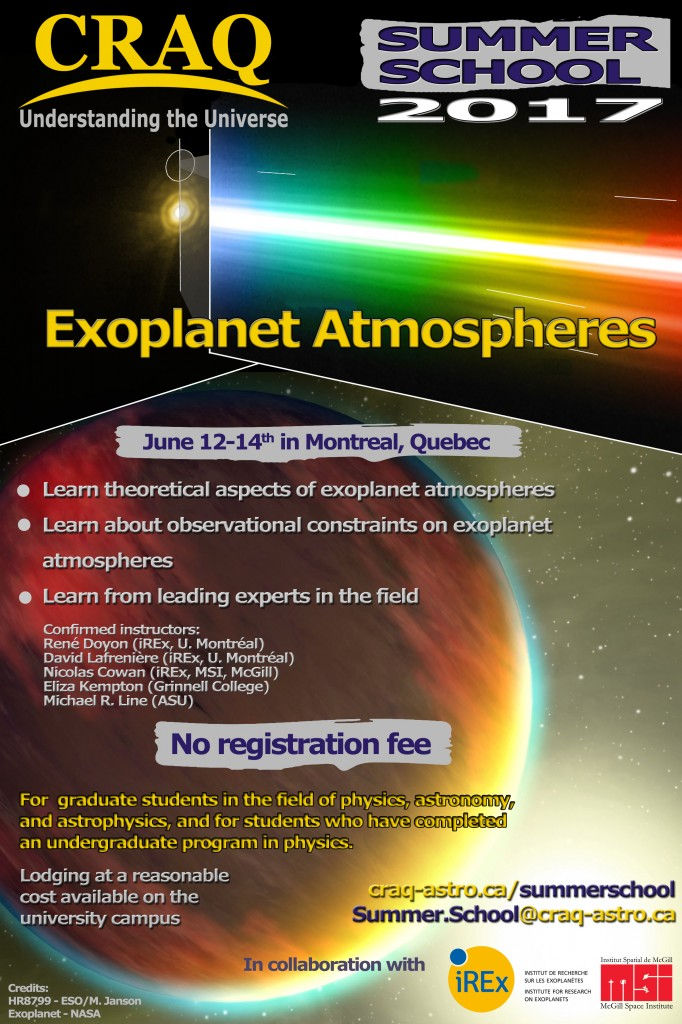
The CRAQ Summer School is principally aimed at graduate students in the field of physics, astronomy, and astrophysics, although students who have completed an undergraduate program in physics will also be accepted.
There is no registration fee. However, we cannot offer traveling funds or cover lodging expenses. Lodging at a reasonable cost will be made available to the participants on the Université de Montréal campus.
Additional information about the program, registration and accommodation will be available soon on this site: craq-astro.ca/summerschool. Email contact: Summer.School@craq-astro.ca
BRITE Constellation Mission Update
From Gregg Wade, BEST Canadian PI (Cassiopeia – Winter 2016)

The mission has matured to the point where it continues in full science operations, 14 data releases to BRITE target PIs have already taken place, and many datasets are in the public domain and available on the BRITE public archive.
The most recent Call for Proposals closed on 01 December 2016, and 15 new proposals for observation are currently being evaluated.
More information about the mission is available on our website: www.brite-constellation.at. General inquiries about BRITE Constellation should be directed to the BEST Chair, Andrzej Pigulski, Univ. Wroclaw, Poland: pigulski@astro.uni.wroc.pl or to Canadian PI Gregg Wade, RMC: wade-g@rmc.ca
Operations
There are five operating BRITE satellites in the Constellation, collecting data on various sky fields in a coordinated programme to obtain well-sampled, long light curves in two bandpasses.
As this issue of Cassiopeia went to press, here was the status of the sky assignments for the BRITE cubesats:
BRITE Toronto (Canada) was collecting red-filter photometry of stars in a field which includes Auriga and Perseus, in tandem with observations of the Vela and Pictoris field. These observations are planned to continue until the late spring of 2017. BRITE Toronto’s performance continues to make it the ‘flagship’ of the BRITE photometric fleet.
UniBRITE and BRITE-Austria (Austria) are monitoring the Cassiopeia and Orion fields in the red and blue bandpasses, respectively. These observations will continue until the early spring of 2017.
Hevelius (Poland) has is observing the Cetus/Eridanus field in the red bandpass. Lem (Poland) obtained some high-quality blue bandpass observations on the Auriga/Perseus field for about 40 days, but has recently encountered serious problems to achieve fine pointing on that field as well as the Vela/Pictoris field. A resolution to this problem is currently being developed.
The BRITE Constellation observing programme from early 2017 through mid-2018 has been planned by the BRITE Executive Science Team (BEST), and details are available on the BRITE photometry Wiki page.
Conferences, resources and social media
Conferences
The 2nd BRITE Constellation Science Conference was held at the University of Innsbruck, Austria, during 22 – 26 August 2016. Nearly 60 scientists took part, and there was a chance for them to interact with Austrian amateur astronomers. The Canadian Trade Commissioner from the Embassy in Vienna was one of the officials to open the meeting, and she attended the first two days of scientific sessions. For details on the programmes, you can visit the conference website. The Conference Proceedings will appear in early 2017.
The 3rd BRITE Constellation Science Conference will be hosted in Canada in August 2017. Conference details will soon be announced.
The second BRITE Spectropolarimetric Workshop occurred in Meudon, France during 14-18 Nov 2016.
The BRITE Public Data Archive, based in Warsaw, Poland, at the Nikolaus Copernicus Astronomical Center, can be accessed at https://brite.camk.edu.pl/pub/index.html
BRITE Constellation is now on Facebook, at @briteconstellationThe mission Wiki (including information on past, current and future fields) can be accessed at brite.craq-astro.ca/
Canadian Gemini News
By Stéphanie Côté (NRC Herzberg)
(Cassiopeia – Winter 2016)
Complete your 2017A PhaseII with ease
Successful PIs of 2017A programs should have received their notification emails from Gemini by now, with instructions on when and how to submit their PhaseIIs. If you happen to be going to the January AAS in Grapevine Texas, then please make sure to drop by the Gemini booth. Support astronomers will be available to sit down with you to get your started with your PhaseII in the Observing Tool (OT) and show you the ropes (in French too if you wish).
If you are not going to the AAS, the next best thing to meet a support astronomer in person is to meet one by Skype. For several semesters now the CGO has been offering help through Skype to provide real-time guidance to the canadian PIs filling out their PhaseIIs. Please contact your assigned CGO support to book a meeting at a mutually convenient time. Don’t be shy to ask for help, the OT has been known to occasionally bring even grown men to tears. We will be waiting for your emails!
GRACES processed data now available in the Archive
GRACES has been very popular with Canadians since its commissioning, it was even the most requested of all instruments in terms of number of proposals for a few semesters. All its science data, along with calibration data, are now accessible from the Gemini archive (more information here). In addition, Gemini staff have done a basic processing of all science data using an early version of the CFHT Opera software and also uploaded this processed data to the archive. Please be aware that this is basically a black box data reduction and you should carefully inspect your data. Let us know if you find any major issues with it. You may use this data as is, but it is not necessarily the optimal reduction and we encourage you to do your own reductions. To this end, there are a couple options you can use. These include the current version of Opera, with a non-optimized set of input files, and an IDL script called DRAGraces (for more information). Please use the Gemini Data Reduction User Forum to post any suggestions or issues you find with the script. A final improved version of Opera is expected to be released within the next few months. We expect to release an improved set of input parameters for use with GRACES around the same time.
Recent Canadian Gemini Press Releases
An international team lead by JF Donati (Toulouse) and including Lison Malo (CFHT), Élodie Hébrard (York University) and René Doyon (Université de Montréal) used GRACES to characterize a newborn “hot Jupiter” orbiting a 2-million-year-old solar-mass T-Tauri star V830 Tau, located in the Taurus stellar nursery. Hot Jupiters are giant planets that formed in the cold outer regions of the protoplanetary disk from which both the central star and surrounding planets are born, and then migrated inwards to settle into orbits 100 times closer to their host stars than our own Jupiter is to the Sun. But how and when this migration is occurring is not known. This new finding is the first evidence that early disk migration is happening. The discovery of this hot Jupiter, orbiting its host star in its infancy, represents a major step forward in our understanding of how planetary systems form and evolve. The paper describing the discovery was published in Nature in June 2016.

In August 2016 an international team including Bob Abraham and Jielai Zhang (University of Toronto) released their findings that the Ultra-Diffuse Galaxy Dragonfly 44, although of similar dynamical mass as the Milky Way, has a dark matter fraction close to 98% within its half-light radius. This very low surface brightness galaxy was discovered just last year in the Coma Cluster with the Dragonfly Telephoto Array developed by van Dokkum and Abraham. The team used DEIMOS on Keck to measure the velocity dispersion and deep g and I imaging with GMOS-N on Gemini. From the deep Gemini image they discovered a remarkable population of close to 100 compact clusters, which they identified as globular clusters. Their results confirm that UDGs seem to be “failed” galaxies, with the sizes, dark matter content, and globular cluster systems of much more luminous objects. You can read the press release and the full ApJL paper.
Update from the Canadian Space Agency (CSA)
By Denis Laurin, Senior Program Scientist, Space astronomy, Space Exploration Development, Canadian Space Agency, with contributions from Jean Dupuis and John Hutchings (Cassiopeia – Winter 2016)
Canadian Space Exploration Workshop – CSEW 2016
The CSA hosted the CSEW workshop on November 24-25 in downtown Montreal. The event was well attended with just over 200 participants from across the country, including 52 astronomers, 70 planetary scientists, 34 space health scientists and 48 other participants in industry and government, as well as many students. The workshop was deemed a success and valuable for everyone. The goal was to enable discussions to update the priorities in these space sciences, and look at opportunities for the next decade and beyond, as a consultation within the framework of the Government of Canada’s Innovation Agenda. The reports of the CSA supported Topical Teams will reflect the outputs of the workshop later next summer. The space astronomy objectives and opportunities were presented in a series of presentations that remain viewable from the CSEW FTP site. A key message from the community was a need for an “ambitious, sustainable, predictable, balanced program.”
I’d like to take this opportunity to thank the organisers of the workshop, especially Victoria Hipkin who championed the event; and for all the work of organizing committee (Denis Laurin, Perry Johnson-Green, Christian Lange, Amira Akrouf and Francine Nowacki). And special acknowledgements to recognize the efforts and preparations by the space astronomy Topical Team Chairs: Douglas Scott, Roberto Abraham, and Luigi Gallo and the Chairs from Planetary Exploration and Space Health.
ASTROSAT
contributed by John Hutchings & Jean Dupuis
Astrosat is in full operation, operating all instruments simultaneously. Satellite and instrument performance is good, and calibrations are well established. Observations of the first cycle of guest observer proposals are now under way, including Canadian programs selected by CanTAC. The second 6-month call for proposals is under way, with a deadline of December 20. Subsequent cycles will be for a full year. Guaranteed instrument team time will continue for another year. Observing efficiency, especially with the UVIT instrument, has improved, but is higher for X-ray instruments which have fewer operating restrictions. Data processing and archiving has been slow, but is now beginning to make up the backlog. Joe Postma (U of Calgary) has developed an independent processing pipeline, which has been the source of most of the UVIT data to date. The first UVIT science paper is in press with ApJ Letters, and other papers are submitted, or in preparation from calibration and Guaranteed Time observations. The figure below shows an NGC 300 Far-UV CaF2 filter image from John Hutchings’ program processed by Joe, showing young stellar populations with approximately 1 arcsec resolution.
JWST
Contributed by Jean Dupuis
Refer to Chris Willott’s contribution to NRC Herzberg News in this Cassiopeia issue about recent and upcoming JWST events. Much information is available on the JWST STScI website such as past and future webcasts that will help astronomers familiarize with this very complex observatory ahead of proposal time. CSA is consulting with the JCSA about how to best support Canadian astronomers during the JWST mission and details about funding opportunities will be announced soon next year.
Wishing everyone great holidays and clear skies
Denis Laurin
Maunakea Spectroscopic Explorer (MSE) Update
By Patrick Hall, MSE Advisory Group Member
(Cassiopeia – Winter 2016)
Ahead of the pack
The Maunakea Spectroscopic Explorer project is moving steadily toward a conceptual design review in mid-2017, followed by a cost review of the conceptual design. Soil load-bearing tests at CFHT are scheduled to begin this month to verify the weight limits for a rejuvenated telescope.
Internationally, the high scientific priority of the ability to conduct massive spectroscopic surveys of faint targets has been highlighted in the past few months in both the USA and Europe, which bodes well for bringing additional partners into MSE.
In the USA, NOAO and LSST released a study of the resources needed to accomplish LSST-enabled science cases (see arxiv:1610.01661) The #1 recommendation, in full, was:
“Develop or obtain access to a highly multiplexed, wide-field optical multi-object spectroscopic capability on an 8m-class telescope, preferably in the Southern Hemisphere. This high priority, high-demand capability is not currently available to the broad US community. Given the long lead time to develop any new capability, there is an urgent need to investigate possible development pathways now, so that the needed capabilities can be available in the LSST era. Possibilities include implementing a new wide-field, massively multiplexed optical spectrograph on a Southern Hemisphere 6-8m telescope, e.g., as in the Southern Spectroscopic Survey Instrument, a project recommended for consideration by the DOE’s Cosmic Visions panel (arxiv.org/abs/1604.07626 and arxiv.org/abs/1604.07821); open access to the PFS instrument on the Subaru telescope in order to propose and execute new large surveys; and alternatively, joining an international effort to implement a wide-field spectroscopic survey telescope (e.g., the Maunakea Spectroscopic Explorer at CFHT or a future ESO wide-field spectroscopic facility) if the facility will deliver data well before the end of the LSST survey.”
In Europe, the “ESO Future of Multi-Object Spectroscopy Working Group Report” (see also this announcement) concluded that
“a large aperture (10-12m class) optical spectroscopic survey telescope … could enable transformational progress in several broad areas of astrophysics, and may constitute an unmatched ESO capability for decades.” The report went on to recommend starting work on what MSE will be delivering next year: “…a conceptual design study aimed at completing a more rigorous, broadly-based science case in the context of a costed technical design. ESO …, noting the financial challenges, may wish to consider establishing links with other international communities …”.
Progress in Canada
Progress on MSE in Canada includes the following:
A contract with EDS for Enclosure design studies.
Conceptual design studies of the Fibre Transmission System at NRC-HAA.
An expected contract with Fibretech Optica for fibre splicing tests.
Submissions to the CFI Infrastructure Fund (PI: Venn) and the Ontario Research Fund (PI: Balogh) for construction of a prototype high resolution spectrograph and development of a science software system for integrated design of surveys, operations, and data analysis.
The CFI proposal team attended a face-to-face Expert Committee evaluation meeting in Toronto in late November, and proposal results should be known in April 2017.
MSE governance
As the MSE project matures, an MSE Management Group (MG) and an MSE Science Advisory Group (SAG) have been constituted. The groups have 2 members each from Canada, France, China, and Hawaii, and 1 member each from India, Australia and Spain.
The MG is charged with making recommendations to the Project Office regarding scheduling, budgeting, partnership opportunities, etc.
The SAG is advisory to the Management Group, and will respond to all requests for scientific recommendations from this group. It will therefore provide high-level guidance to the MSE Project Scientist (Alan McConnachie, NRC-HAA) on the science‐related development of MSE. For example, the SAG is expected to provide advice in 2017 regarding science priorities that will feed into the conceptual design cost review.
Greg Fahlman (NRC-HAA) and Patrick Hall (York) represent Canada in the MG, and Kim Venn (Victoria) and Sarah Gallagher (Western) represent Canada in the SAG.
The MG had its first face-to-face meeting on December 12 in Waimea, and the Chair of the MG, Jean-Gabriel Cuby (Marseille), joined the Project Office in presenting a progress report to the CFHT board on December 15.
Last but not least
Congratulations to Alan, Isla, and Callum McConnachie on the newest addition to their family: Alexander Edward McConnachie.
And best wishes for the new year to CASCA members, from all involved with MSE.
The NRC Herzberg Cassiopeia Report
From Dennis Crabtree (NRC-Herzberg) with contributions from Chris Willott
(Cassiopeia – Winter 2016)
These reports will appear in each issue of Cassiopeia with the goal of informing the Canadian astronomical community on the activities at NRC Herzberg.
Feedback is welcome from community members about how NRC Herzberg is doing in fulfilling our mandate to “operate and administer any astronomical observatories established or maintained by the Government of Canada” (NRC Act).
Canadian Time Allocation Committee (CanTAC)
CanTAC met in November to discuss and rank CFHT and Gemini proposals for semester 2017A. A few CanTAC members, including all the Chairs, met in Victoria while the remainder of CanTAC connected by telecon. The CanTAC SuperChair for this meeting was Scott Chapman (Dalhousie), while the Galactic panel chair was Stanimir Metchev (Western) and the Extragalactic panel chair was Eric Steinbring (NRC Herzberg). Dennis Crabtree continues to serve as the technical secretary.
The full list of CanTAC members for the November meeting was:
Galactic | Extragalactic |
Laurent Drissen (Laval) | Arif Babul (Victoria) |
Christopher Johns-Krull (Rice) | Peter Capak (Caltech) |
Stanimir Metchev (Western) | Scott Chapman (Dalhousie) |
Leslie Rogers (Caltech) | Julie Hlavacek-Larrondo (Montreal) |
Samar Safi-Harb (Manitoba) | Eric Steinbring (NRC) |
Ingrid Stairs (UBC) | Ludo van Waerbake (UBC) |
Peter Stetson (Herzberg) |
For Semester 2017A CanTAC received 33 CFHT proposals (18 Galactic and 15 Extragalactic) and 39 Gemini proposals (24 Galactic and 19 Extragalactic). There was a total of 532 hours requested on CFHT and 371 hours on Gemini. The subscription rates were 2.81 for CFHT, 2.36 for Gemini North and 2.43 for Gemini South.
The demand for both telescopes increased significantly from the last semester.
Canadian Astronomy Data Centre (CADC)
Common Archive Observation Model (CAOM) Data Modelling Workshop
The CADC hosted a 2-day data modelling workshop in Victoria Dec 6–7. Several years ago, the CADC moved all its data collections to a Common Archive Observation Model (CAOM) which allows a single interface to query all of these data collections. CAOM also facilitates providing access to these collections via International Virtual Observatory Alliance (IVOA) services. The CAOM data model has been adopted by the Mikulski Archive for Space Telescopes (MAST) at STScI and is the baseline data model for JWST and SKA.
The CAOM has attracted significant attention from other projects. This interest prompted CADC and STScI to organize and co-host this small, invitation-only 2-day workshop to bring interested parties (18 current and potential users) together to discuss the data model and how to support it as an open source community project. The workshop was followed by a 1-day hackathon where CADC and STScI staff worked with new participants to round trip their example datasets from metadata ingestion into the CAOM databases through to querying and retrieval with a browser query interface and/or IVOA protocols.
JWST Update
16 days! That is all between now and the release date of the first opportunity to apply for observing time on the James Webb Space Telescope (JWST). A call for Notices of Intent for Early Release Science proposals will be issued on the 6th January 2017. The Early Release Science (ERS) program is a Director’s Discretionary Time program that aims to exercise many of the JWST observing modes early in the first cycle, putting data into the hands of all prospective users in time to inform their cycle 2 proposals. Full ERS proposals are due in August 2017 and will be selected based on scientific merit plus additional factors relating to the goal of informing the community on JWST capabilities, data processing techniques and scientific analysis. The call for regular Cycle 1 proposals will follow in November 2017.


To support prospective users of the telescope there are many tools being made available at the Space Telescope Science Institute including the Astronomer’s Proposal Tool, Exposure Time Calculator and new JWST Documentation. In addition a series of webcast community lectures provide information on applying for JWST time and how best to use the wide range of observing modes to carry out your science. In October 2016 the Université de Montréal organized a very successful conference, “Exploring the Universe with JWST – II”, bringing together scientists from around the world to discuss how JWST can tackle many important science questions.
Now that the instrument module has been integrated into the telescope, JWST will go through a series of tests to ensure the telescope will meet the expected optical and thermal performance. After that the telescope will be integrated with the spacecraft and five-layer sunshield that keeps the telescope and instruments cool. JWST remains on schedule for launch on an Ariane V rocket in October 2018.

Comments