Cassiopeia Newsletter – Vernal Equinox 2016

Updated: Aug 22, 2025

Date: March 21, 2016
In this Issue:
President’s report
News from Discover the Universe
CRAQ 2016 Summer School
Jim Hesser Is Awarded the Schneider Medal
ALMA Matters
BRITE-Constellation News
Update from the Canadian Space Agency
Gemini Update / Nouvelles de Gemini
Herschel-HIFI News
Maunakea Spectroscopic Explorer Update – Mid-Term Review, Collaboration Meeting, and More
NRC Herzberg News
Square Kilometre Array Update
TMT Update
Editor: Magdalen Normandeau & Joanne Rosvick
Cassiopeia is CASCA’s quarterly Newsletter, published on or near the solstices and equinoxes (March 21, June 21, September 21 and December 21).
To submit a contribution please email cassiopeia.editors@gmail.com. All submissions must be received by the due date (usually 2 weeks in advance of publication) to be published in the next edition. I accept plain text and Word documents. Note that the formatting of your document will not be preserved. Please include any images as attachments in your email, not embedded in the text. Please include URLs in parentheses next to the word or phrase that you wish to act as link anchors.
President’s Report
By Chris Wilson, CASCA president (Cassiopeia – Spring 2016)

Hi, everyone,
Spring is in the air, and that means it is time to start planning your trip to the next annual CASCA meeting, to be held this year in Winnipeg, Manitoba. Registration is now open and the abstract submission deadline is April 8. More information is available on the meeting web site. The graduate student workshop will be on May 30th, 2016 with the CASCA meeting itself May 31st – June 2nd, 2016. In addition, there will be a half-day meeting on the status and future of ground-based submillimetre astronomy in Canada on Friday, June 3rd. The meeting will be held at the historic Fort Garry Hotel, located in the heart of Winnipeg, within easy walking distance of many attractions such as The Forks and the Canadian Museum for Human Rights. Our new Diversity and Inclusivity Committee has drafted a meeting Code of Conduct that is being reviewed by the CASCA Board. There will also be a special plenary session on diversity and inclusivity at the meeting itself.
The Westar Lecture series is planned to resume in 2016. The new model for this series will combine a Westar lecture by an astronomer with hands-on teacher training activities offered by Discover the Universe. An ad hoc Westar committee has been formed to coordinate planning; the committee consists of Lorne Nelson for the CASCA board, Julie Bolduc-Duval for Discover the Universe, and Phil Langill from the Unviersity of Calgary. The EPO Committee will select the initial lecturers. We are planning to target more remote sites without good connections with a local university, possibly in northern Canada.
Many of you will have seen the announcement on February 16, 2016 that Vicky Kaspi has been awarded the Gerhard Herzberg Canada Gold Medal for Science and Engineering from the Natural Science and Engineering Research Council. It is great to see a member of our community recognized with this high-profile national award! Vicky is also the first woman ever to be awarded the Herzberg medal. Congratulations to Vicky on this well-deserved award!
Spring is also the time when we announce our CASCA award winners. Our winners this year are
Chris Pritchet (University of Victoria) for the Carlyle S. Beals Award for groundbreaking research
Peter Stetson (NRC Herzberg) for the Dunlap Award for Innovation in Astronomical Research
Jonathan Gagné (Carnegie Institute for Science) for the J. S. Plaskett Medal for the most outstanding doctoral thesis
Jaymie Matthews (University of British Columbia) for the Qilak Award for astronomy communications, public education, and outreach
Ralph Pudritz (McMaster University) for the Executive Award for outstanding service
Congratulations to all our award winners and I look forward to seeing you at the CASCA meeting in Winnipeg!
Work on the report from the Mid-Term Review panel is very nearly finished. An initial draft was released to the community for a two-week comment period on February 23. The final revisions are nearly done and we expect to release the final report (electronically, English only) any day now. The report will be translated into French and printed in both official languages, which will take additional time.
Early in the new year, the Coalition for Canadian Astronomy reached out to the new Federal Government, with letters to key ministers followed up by a face-to-face meeting with the Minister for Science, Kirsty Duncan, in Ottawa on February 25. We took this opportunity to introduce the minister and her staff to our long range planning process and to highlight key facilities from that plan, including the Thirty Meter Telescope, the Square Kilometre Array, and WFIRST. The tone of the meeting was very cordial and the new minister appears very interested in hearing about the exciting science that our community does, which is very encouraging.
In facility news, the TMT situation continues to evolve slowly, with meetings by the TIO Board in February 2016 and the beginning of a process to review possible alternative sites for the telescope (see contribution from Ray Carlberg in this newsletter). The Canadian Space Agency celebrated the successful launch on March 17, 2016 of Hitomi (formerly known as ASTRO-H), a new Japanese X-ray telescope with which Canada is involved. The CSA has also released a Request for Proposals for Phase 0 studies for the WFIRST mission, which is an important and necessary step towards ultimately securing Canadian participation in this Dark Energy mission.
Finally, one of the annual tasks of the CASCA President as chair of the Canadian National Committee for the IAU is to submit our “Annual Performance Review” to the National Research Council. This report is important as it helps to justify the payment of our annual membership dues (29,000 Euros in 2016) to the IAU. This year we continued our tradition of excellence and achieved a rank of 3 out of 28 Canadian National Committees across a wide range of disciplines that submitted reports for 2015.
News from Discover the Universe
From Julie Bolduc-Duval, coordinator (Cassiopeia – Spring 2016)
As you may know, CASCA has been involved in the teacher-training program Discover the Universe (DU) since its beginning in 2011. Here are some highlights from the last few months:

In November 2015, we offered our first international workshop, thanks to funding from the IAU’s Office for Astronomy Development. We reached 176 (French-speaking) teachers from 11 countries on 3 continents. The content of the workshop is now available to astronomy and education professionals in Africa to share with teachers who couldn’t participate in the online workshop due to limited internet access.
Funding received in 2015 from the Quebec government allowed us to create an activity kit for after-school programs. This kit, which includes an 80-page manual as well as 6 videos, is only available in French for now but we would like to translate it in the future. It’s available for free on our website.
In 2016, the Dunlap Institute for Astronomy & Astrophysics at the University of Toronto joins us as a major partner. This is great news for us as we are now able to grow our program. Our goal is to develop more resources for teachers and offer more workshops online and across the country. DU remains a national and bilingual program.
If you are interested in teacher training, have already developed resources or simply find the idea interesting, please let me know! We hope to create a network of interested people in different universities and research institutes across Canada.
Centre for Research in Astrophysics of Québec 2016 Summer School
From/de Robert Lamontagne (Cassiopeia – Spring 2016)
The Centre for Research in Astrophysics of Québec (CRAQ) is announcing its first Summer School, which will be held on August 24-26th in Montréal, Québec.
This year’s topic is “The Astrophysics of Compact Objects”. During this 3-day school you will learn both theoretical and observational aspects of white dwarfs, neutron stars, and black holes. This summer school will include formal lectures from local and international experts in the field, as well as laboratories on data handling and analysis.
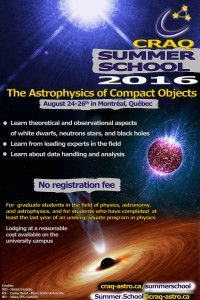
The CRAQ Summer School is principally aimed at graduate students in the field of physics, astronomy, and astrophysics, although students who have finished at least the last year of an undergraduate program in physics will also be accepted.
There is no registration fee. However, we cannot offer traveling funds or cover lodging expenses. Lodging at a reasonable cost will be made available to the participants on the university campus.
If you are interested, please fill in the required fields at the following address:craq-astro.ca/summerschool.
Email contact: Summer.School@craq-astro.ca
Jim Hesser is awarded the Schneider Medal
From Marilyne Lavoie, Media Relations Officer, NRC (Cassiopeia – Spring 2016)
Dr. James (Jim) Hesser, an internationally known astronomer and accomplished NRC manager, is the recipient of the 2015 W.G. Schneider Medal. Dr. Hesser exemplifies the criteria set for the award, which recognizes those who have made outstanding contributions to NRC “above and beyond” the expectations of their job duties and who exemplify NRC values.
Dr. Hesser’s career is marked by decades of scientific leadership and public service in global astronomy and astrophysics. After receiving his PhD from Princeton and starting his astronomy career in Chile, Jim joined NRC as a research officer (RO) in 1977. His leadership skills were soon recognized and in 1986 he was appointed Director of the Dominion Astrophysical Observatory (DAO) in Victoria, BC.
Throughout this 36-year tenure at NRC Dr. Hesser oversaw scientific and technology development work that helped Canada advance its global presence in world astronomy. His service in high offices of all major North American professional societies in his field, as well as on the boards of preeminent international observatories, has strengthened the network of global collaborations that characterize NRC’s Herzberg Astronomy and Astrophysics (NRC Herzberg) programs today.
Jim’s impact has also been profound on NRC and on the broad Canadian astronomy community. Dr. Hesser’s research on the chemical evolution of the early universe through the study of star clusters was ground-breaking and helped attract top talent to NRC for many years. His mentoring helped many prominent astronomers develop their professional careers. Through his long-time involvement in the Victoria chapter of the Royal Astronomical Society of Canada (RASC) and the volunteer-based Scientists and Innovators in the Schools, Jim has done much to bring astronomy to the public at large, culminating with his work as Canadian Chair of the International Year of Astronomy in 2009.
Jim retired as DAO Director – the longest-serving in the observatory’s history – in 2014, but his service continues. As Strategic Advisor to the General Manager for NRC Herzberg, he continues to mentor students and researchers while strengthening important stakeholder relationships. This relationship building has contributed to the establishment of the not-for-profit “Friends of the DAO Society” dedicated to supporting science outreach activities at the purpose-built visitor centre playfully named the Centre of the Universe (CU). CU is located adjacent to the NRC observatory’s historic Plaskett telescope.
As NRC celebrates its Centennial year just ahead of the Centennial of that pioneering telescope named after DAO’s founding Director John Stanley Plaskett, it is certainly fitting that an astronomer of Jim Hesser’s calibre is the recipient of the Schneider Medal. “John Plaskett put Canada’s observatory on the map,” notes NRC Herzberg GM Greg Fahlman. “Jim’s legacy is helping keep it there.”
ALMA Matters
From/de Gerald Schieven (Cassiopeia – Spring 2016)
Cycle 4 Call for Proposals
On March 22, the JAO will issue a call for ALMA proposals for Cycle 4, with observations starting 4 October 2016 and running through to the end of September 2017. The proposal deadline is 21 April. Several new capabilities are being offered in Cycle 4, including mm-wave VLBI, solar observing, stand-alone Atacama Compact Array (ACA) proposals, and long-term proposals (>50h). Check the Proposer’s Guide available from the ALMA Science Portal for the full list of capabilities and details about proposing.
Those who would like an in-depth introduction to proposing with ALMA may wish to attend one of the workshops being held March 31 at McMaster University and April 8 at DAO in Victoria. See the next item for more information.
ALMA Days Workshops
The Millimetre Astronomy Group (MAG) at NRC, in their capacity as members of the NAASC supporting ALMA users in North America, will host two “ALMA Days” prior to the Cycle 4 ALMA proposal deadline (21 April 2016). These follow a very successful NRAO Live! event at McGill University in Montreal run by NRAO’s NAASC members with assistance from Brenda Matthews from the MAG. In the coming weeks, members of the MAG will provide 1-day workshops at McMaster University in Hamilton, ON (31 March) and at DAO in Victoria, BC (8 April) to assist those planning ALMA proposals. The focus will be on presenting the ALMA facility, new capabilities and changes to previous modes for Cycle 4, the Observing Tool and using ALMA simulators.
Participants should bring a laptop with the ALMA OT (and CASA — the ALMA DR software — if they wish to test the simulator) installed.
Topics to be covered include:
ALMA Overview + Cycle 4 Capabilities
Basics of Radio Interferometry
The Proposal Process and the Path of ALMA Observations
Overview of the ALMA OT
Hands-on Session with the OT for proposal preparation
The ALMA Simulator Tool in CASA
Those interested in attending should communicate with Brenda Matthews (brenda.matthews@nrc-cnrc.gc.ca).
Forum on Canadian Future of Ground-Based Submm Astronomy, Friday June 3 in Winnipeg
ALMA is now approaching full operations and many members of our Canadian community have applied to and used this facility to further their research goals. At the same time, several groups in Canada are actively involved in ALMA Development opportunities to further the scientific capabilities of this ground-breaking facility (see two reports below). Our community faces a less certain future regarding access to single dish facilities, however. There continues to be uncertainty around CCAT’s schedule and funding status. These difficulties are having an impact on CCAT’s design (such as removing the enclosure) that may affect the potential science of this planned facility. Many researchers in the Canadian community continue to work to maintain Canada’s status in the CCAT project. At the same time, our access to the EAO-operated JCMT has an indeterminate future beyond Jan 31 2017. Access to PI time on the JCMT is open for now to all members of the Canadian community, and many members of the community are involved in the new wave of large surveys with the JCMT. The amount of PI time however is limited. NRC is no longer involved in the management of the JCMT on behalf of the Canadian community, but those actively utilizing JCMT for their science are exploring avenues to provide new instrumentation to the facility.
Given the recommendation of the MTR panel, specifically: “Recommendation: The MTRP reaffirms the importance of next generation single-dish sub-mm facilities, and recommends that Canadian astronomers continue to pursue participation in CCAT, subject to the project meeting its original science goals”, the timing is right for the community to have a frank and open discussion about access to CCAT and JCMT, the timelines for each, and the distribution of effort to ALMA and either or both of these single dish facilities.
Interested members of the community are therefore invited to a face-to-face meeting on the “Status and Future of ground-based submillimetre astronomy in Canada” to follow the CASCA AGM on Friday, 3 June 2016. We will hold the meeting in the CASCA meeting venue from 9am to 12:30pm. The agenda is not yet decided, but we will ask for updates on the three facilities and have lots of time for discussion. There is no charge to attend. We do ask those planning to attend to indicate their interest via email to Erik Rosolowsky (rosolowsky@ualberta.ca) by 27 May 2016.
Call for Development Study Proposals
All interested parties within the North American ALMA partnership are invited to submit proposals for “Development Studies of Upgrades for the Atacama Large Millimeter/submillimeter Array (ALMA)”. Proposals are due 2 May, 2016. Full information about this call, and the level of funding available, can be found at the following link:science.nrao.edu/facilities/alma/alma-development-cycle4/call-for-proposals-study
This Call is to invite proposals to conduct studies of ideas that may be further developed and implemented in a subsequent funding cycle. The primary aims of this Call for Project Proposals are to:
encourage the flow of development ideas from the North American ALMA operations community into the ALMA Development Program Plan;
support the development of conceptual and detailed designs by the North American ALMA operations community for possible future inclusion in the ALMA Development Program Plan; and
support ALMA-relevant, long-term research and development by the North American operations community.
For examples of ALMA Development Projects that began as Development Studies, see the next two items on CARTA and on Band 3 upgrades.
CARTA – An ALMA Data Analysis and Visualization Tool
Through the ALMA Development Program, the University of Alberta and the University of Calgary are collaborating with NRAO to create CARTA — the Cube Analysis and Rendering Tool for Astronomy. CARTA is a visualization project that aims to provide the functionality of the CASA viewer combined with the stability and performance that comes with a modern application. Currently, the CARTA project has developed the core application and is rapidly implementing new features to deliver the tools that radio astronomy users need. The CARTA project will deliver the software to the ALMA project on Sept. 1st where it will become part of the CASA software package. If you would like to participate in the beta testing of CARTA, please contact Erik Rosolowsky (rosolowsky+carta@ualberta.ca) or visit our webpage to download a beta version.
Band 3 Cartridge Upgrades
Over the past few years, the Millimetre Instrumentation Group at NRC Herzberg in Victoria has been developing and testing options for improving the stability of the Band 3 receivers on ALMA. The solution adopted, block heaters for on-demand magnetic field defluxing of the SIS mixers, has been implemented and validated on one cartridge which has now arrived in Chile. Over the next few years, this upgrade should be gradually applied to all Band 3 cartridges as the Front End cryostats cycle through the ALMA laboratory for routine maintenance. This should result in improved power stability with an additional small enhancement in sensitivity.
ALMA Instructional Videos
The NRC MAG has been producing instructional videos for ALMA. The most recent is a short (6 minute) film on using single-dish data to estimate ALMA sensitivity requirements. An earlier video explores what “Largest Angular Structure” and “Maximum Recoverable Scale” mean.
BRITE-Constellation News
Submitted by Gregg Wade (Cassiopeia – Spring 2016)
Introduction
BRITE-Constellation (where BRITE stands for BRIght Target Explorer) is a network of five nanosatellites operating in low Earth orbit, designed to explore the properties of the brightest stars in the night sky.

The BRITE mission is supported by three countries — Canada, Austria and Poland — where Canadian funding comes mainly from the Canadian Space Agency (CSA) and the prime contractor is the University of Toronto Institute for Aerospace Studies – Spaceflight Laboratory (UTIAS-SFL). The mission was planned to have 6 BRITE nanosats, a pair from each partner country, but one of the Canadian nanosats did not detach from the third stage of its launch vehicle.
Each BRITE nanosat (mass = 7 kg; dimensions 20 × 20 × 20 cm) has a 3-cm optical telescope feeding a CCD detector. The Constellation was designed to monitor photometrically through blue and red filters the brightness and temperature variations of stars generally brighter than V ~ 4 with precision, cadence and time coverage not possible from the ground. Each BRITE instrument has an enormous field-of-view: 24° square, large enough to encompass the entire constellation of Orion (but at a resolution of only about half an arcminute per pixel). That means BRITE-Constellation can collect data on several dozens of stars simultaneously.
The sample of the apparently brightest stars in the night sky is a sample dominated by the most intrinsically luminous stars in the Galaxy: hot massive stars at all evolutionary stages, and evolved intermediate-mass stars at the very end of their nuclear-burning phases. The main goals of BRITE-Constellation are to (1) measure the frequencies of pulsations (both acoustic and gravity modes) to probe the interiors and ages of stars through asteroseismology; (2) measure the rotational modulation of stars due to star spots carried across their disks; (3) search for exoplanets through transits; and (4) obtain light curves of massive eclipsing binaries. While goal (2) is often associated with cool solar-type stars, spots in the photospheres of luminous stars could be the sources of co-rotating interaction regions in the winds, possibly arising from magnetic subsurface convection in hot, massive stars.
![Hertzsprung-Russell diagram of the stars of brightest apparent magnitude, V<4.5. These ∼ 600 stars are the primary BRITE targets.[/caption] To develop the optimum data processing and reduction strategies, a BRITE Photometry Tiger Team (PHOTT) was assembled. PHOTT explored and compared various pipelines and ways to minimise data artifacts. To extract the maximum scientific value from the reduced BRITE photometry, the BRITE Ground-Based Observations Team (GBOT) organizes ground-based observing campaigns, primarily high-resolution, high-S/N spectroscopy of BRITE targets. A detailed overview of the scientific motivation of the mission, and technical aspects of the system, are provided by Weiss et al. (2015, PASP 126, 573).](https://static.wixstatic.com/media/987aaf_d58b242a766e4d89a275925f44486ab9~mv2.jpg/v1/fill/w_509,h_385,al_c,q_80,enc_avif,quality_auto/987aaf_d58b242a766e4d89a275925f44486ab9~mv2.jpg)
Mission Status and Data Releases
Five of the planned six BRITE nanosats are currently operating in low-altitude (600-800 km) orbits. The first pair of BRITE nanosats (from Austria) were launched on 25 Feb 2013, and the Canadian BRITEs were launched in August 2014 aboard a Russian rocket. The sixth satellite currently remains unusable in a higher elliptical orbit due to a malfunction in the release mechanism of the Russian rocket third stage.
A new ground station capability has been developed at UBC and will soon come on-line, permitting greater data downlink capability.
Ten data releases to BRITE Target PIs have occurred so far. The first was a set of science commissioning data, including about 5 months of quasi-continuous observation of 15 stars in Orion. Subsequent releases were 6-month campaigns of fields in Centaurus and Lupus (30 stars), Sagittarius (18 stars), Cygnus (37 stars), and Perseus (31 stars). Orion was observed again. Most recently, a field in Vela and Puppis was observed (20 stars). Data from the recently-completed Scorpius (26 stars), Cygnus-II (34 stars) and Cassiopeia/Cepheus (25 stars) fields have just been released.

The first BRITE science results have been accepted in refereed journals: Three science papers by Weiss et al. on the pulsating magnetic star alpha Cir, by Baade et al. on the short-term variability and mass loss of the Be stars mu and eta Cen, and by Pigulski et al. on the triple system beta Cen (a complex system containing at least one beta Cep pulsator) have been published together in issue 588 of Astronomy and Astrophysics.
The first BRITE science conference, “Science with BRITE Constellation: Initial Results” took place during 14 – 18 September 2015 in Gdansk Sobieszewo, Poland. Presentations authorised for public release are available on the conference website. The next BRITE science workshop is planned from 22-26 August in Innsbruck, Austria.
A workshop related to a large-scale spectropolarimetric survey of BRITE targets was held at the MeudonObservatory on October 26-30, with 19 participants. The BRITE spectropolarimetric survey is proceeding nominally, with expected completion in March 2016. Magnetic field has been detected in 47 stars so far, and follow-up observations are being acquired or planned for many of them. Two papers have already been published (Shultz et al. 2015, Neiner et al. 2015) and many others are in preparation. A second BRITE spectropolarimetric workshop will be organized from 14-18 November 2016 at the same location.

Mission Management and Contact
Executive decisions about the mission are made by the BEST (BRITE Executive Science Team), consisting of representatives from all three partner nations. The Canadian BEST members are Jaymie Matthews (UBC), Tony Moffat (Université de Montréal), Slavek Rucinski (University of Toronto), and Gregg Wade (BEST Vice-Chair, Royal Military College), with Jason Rowe (Université de Montréal) and Stefan Mochnacki (University of Toronto) serving as non-voting BEST members.
Setting priorities on BRITE targets and science goals was overseen by BEST, with input from the BRITE International Science Advisory Team (BIAST), consisting of 130 astronomers around the globe. Interested in joining BIAST, to participate in data analysis, and receive monthly mission updates? Please contact BEST through Gregg Wade (wade-g@rmc.ca).
Baade, D.; Rivinius, Th.; Pigulski, A.; Carciofi, A. C.; Martayan, Ch.; Moffat, A. F. J.; Wade, G. A.; Weiss, W. W.; Grunhut, J.; Handler, G.; Kuschnig, R.; Mehner, A.; Pablo, H.; Popowicz, A.; Rucinski, S.; Whittaker, G., 2016, “Short-term variability and mass loss in Be stars. I. BRITE satellite photometry of η and μ Centauri”, A&A, 588, 56
Neiner, C.; Buysschaert, B.; Oksala, M.E.; Blazère, A., 2015, “Discovery of two new bright magnetic B stars: i Car and Atlas”, MNRAS 454, 56
Pigulski, A.; Cugier, H.; Popowicz, A.; Kuschnig, R.; Moffat, A. F. J.; Rucinski, S. M.; Schwarzenberg-Czerny, A.; Weiss, W. W.; Handler, G.; Wade, G. A.; Koudelka, O.; Matthews, J. M.; Mochnacki, St.; Orleański, P.; Pablo, H.; Ramiaramanantsoa, T.; Whittaker, G.; Zocłońska, E.; Zwintz, K.; 2016, “Massive pulsating stars observed by BRITE-Constellation. I. The triple system beta Centauri (Agena)”, A&A, 588, 55
Shultz, M.; Rivinius, Th.; Folsom, C. P.; Wade, G. A.; Townsend, R. H. D.; Sikora, J.; Grunhut, J.; Stahl, O.; and the MiMeS Collaboration, “The magnetic field and spectral variability of the He-weak star HR 2949”, 2015, MNRAS 449, 3945
Weiss, W.W.; Rucinski, S.M.; Moffat, A.F.J.; Schwarzenberg-Czerny, A.; Koudelka, O.F.; Grant, C.C.; Zee, R.E.; Kuschnig, R.; Mochnacki, St.; Matthews, J.M.; Orleanski, P.; Pamyatnykh, A.; Pigulski, A.; Alves, J.; Guedel, M.; Handler, G.; Wade, G.A.; Zwintz, K., 2014, “BRITE-Constellation: Nanosatellites for Precision Photometry of Bright Stars”, PASP 126, 573.
Weiss, W.W.; Frohlich, H.-E.; Pigulski, A.; Popowicz, A.; Huber, D.; Kuschnig, R.; Moffat, A.F.J.; Matthews, J.M.;, Saio, H.; Schwarzenberg-Czerny, A.; Grant, C; Koudelka, O.; Lueftinger, T.; Rucinski, S.; Wade, G.A.; Alves, J.; Guedel, M.; Handler, G.; Mochnacki, S.; Orleanski, P.;, Pablo, B.; Pamyatnykh, A.; Ramiaramanantsoa, T; Rowe, J.; Whittaker, G.; Zawistowski, T.; Zoconska, E.; Zwintz, K., 2016, “The roAp star alpha Cir seen by BRITE-Constellation”, A&A, 588, 54
Update from the Canadian Space Agency
From Denis Laurin, Senior Program Scientist, Space astronomy, Space Exploration development, CSA, with contributions from Jean Dupuis, Senior mission scientist, and Vinothini Sangaralingam, Visiting Fellow (CSA / NSERC)
(Cassiopeia – Spring 2016)
New Government
Following the elections in October, with a majority Liberal government, is the introduction of the new Ministry of Innovation, Science, and Economic Development (Minister Hon. Navdeep Bains). The Canadian Space Agency reports to this Ministry (formerly to the Ministry of Industry). The nomination of Hon. Kristy Duncan as Minster of Science should also be noted. Mandate letters from the Prime Minister to these ministers are viewable: the mandate letter to Hon. Bains and the mandate letter to Hon. Duncan. It is worth noting the expectations to create a Chief Science Officer, making science fully available to Canadians. Sylvain Laporte has been the CSA President since February 2015.
CASCA LRP and MTR
For establishing priorities, validating plans and updating long-term space mission roadmaps, the input of the community is very important to CSA. The CASCA Long Range Plan provides this coordinated input of science priorities, alignment with Canadian capacity and international opportunities. CSA appreciated the opportunity to comment on the review process and will consider the recommendations of the Mid-term Review.
WFIRST Opportunity
As described in the LRP, participation in NASA’s mission on Dark Energy survey and exoplanet imaging, WFIRST, is considered a high priority opportunity. In 2014, CSA completed mission contribution studies to evaluate a number of possible options. Continued discussions with NASA has narrowed down the options and CSA is currently advertising a Request for Proposal (RFP) for a Phase 0 (study) that will provide more details on feasibility, cost, and schedule, and better evaluate these options. (The RFP is currently open on buyandsell.gc.ca and any questions related to the call must be directed at PWGSC as indicated in the RFP.)
Launch of ASTROSAT
Contributed by Jean Dupuis, Senior Mission Scientist, CSA
ISRO’s first astronomy mission, the X-ray and UV space observatory ASTROSAT was successfully launched on 28 September 2015. It carries a Canadian contribution, the UVIT imager assembly and readout electronics. The mission is in the performance verification phase (first 6 months) and has so far demonstrated excellent functionality. A six-month period of Guaranteed Time Observation (GTO) for the science instrument teams will follow. A Guest Observer program will start about one year after launch for which 5% of the observing time is reserved for Canada. Science support to UVIT is provided by the University of Calgary team (Joe Postma and Denis Leahy) and by John Hutchings at NRC-Herzberg.
Launch of ASTRO-H (Hitomi)
JAXA launched its X-ray observatory ASTRO-H (now named Hitomi) on Feb 17, 2016. The launch could be watched live on YouTube and some Canadians were present on site to witness a flawless launch to orbit. The spacecraft is in the commission (verification) phase. Canada’s contribution is the Canadian ASTRO-H Metrology System (CAMS) by Neptec Design Group (Ottawa). The CAMS units consist of two main components: a laser transmitter with receiver optics and retro-reflective targets, to monitor the translation and rotation of the Hard X-ray telescope (HXT) extendable boom. Details are available on CSA website.
The Canadian scientists part of the Japanese Hitomi team are Dr. Luigi Gallo, Principal Investigator for CAMS, of Saint Mary’s University; Dr. Brian McNamara of the University of Waterloo; and Dr. Samar Safi-Harb of the University of Manitoba.
JWST preparations
contributed by Jean Dupuis
The project is progressing well with the recent completion of the third cryogenic vacuum test campaign (CV3) held at the Goddard Space Flight Center (GSFC). The Canadian JWST team is busy completing the analysis of the data obtained during the test campaign and getting ready for the next test campaign to be held next year at the Johnson Space Center (JSC) with the flight telescope. With launch approaching (October 2018) the team is also making necessary preparations for commissioning and operations. The FGS/NIRISS science team is also actively planning proposals for the utilization of the Guaranteed Time Observation (GTO) granted to the team in return for Canada’s contribution to JWST (450 hours). A GTO workshop will be held May 17-19 at NRC-Herzberg in Victoria, BC, for all the JWST science instrument teams. A JWST science conference open to all Canadian astronomers will be held at the Université de Montréal Oct 24-28. Your participation is highly encouraged. At least 5% of the observing time will be allocated to Canadian proposals during the JWST Guest Observer program and this conference will be an excellent opportunity for future users of JWST to learn about the capabilities of this powerful observatory and to think about and promote potential projects. CSA is exploring with CADC the possibility of hosting a mirror of the JWST archive in Canada
MOST archive
Contributed by Dr. Vinothini Sangaralingam, Visiting Fellow (CSA / NSERC).
The MOST (Microvariability & Oscillations of STars) microsatellite collected ultraprecise photometry of thousands of targets for almost 11 years as a Canadian Space Agency mission since 2003. Stars dominate the target list, but the sample includes Solar System planets and asteroids, totaling 268 primary targets with more than 4000 secondary targets in the V magnitude from -1 to 16.
AMSA (Advanced MOST Science data Archive) will be a repository of the decade long data obtained by the MOST satellite and its data products as produced by the MOST science team and its direct collaborators. AMSA will be accessible on the CADC (Canadian Astronomical Data Centre) servers using their Advanced Search (AS) protocols. Archive users can search and download the data base using extensive parameters (Target name, PI Name, Sky co-ordinates, etc.) available through the AS webpage. MOST data available through AMSA would have potential value to the community on par with the ASAS & HIPPARCOS catalogues of stellar optical time series, in terms of metadata, access and searchability.
The technical end of this project in terms of database development, access and restrictions, storage and security, front-end portals have been achieved within the CADC`s CAOM architecture. Currently, work is in progress uploading the raw and reformatted (to conform to CAOM requirements) data from CSA servers to CADC servers. The reduced light curves are being uploaded by the MOST science team and its archivist simultaneously. This is expected to be complete by the end of March and testing of this database will begin in April, 2016. The MOST Science Team will soon release publicly all MOST Guide Star photometry (3030 light curves) along with the published light curves through this archive. However, proprietary data will become available once a publication has been made on the data or when the light curves are released by the PI.
I’d like to acknowledge the excellent efforts provided by Vinothini Sangaralingam, working at CSA in collaboration with Université de Montréal, and also by David Bohlender at CADC in implementing this archive, and of course the MOST PI Jaymie Matthews and the science team for their continued collaboration. – D. Laurin
FAST Program
The objectives of the Flights and Fieldwork for the Advancement of Science and Technology (FAST) program is to support Canadian university research projects that offer hands-on experience to students, post-docs (and other HQP) in “space-like” missions. The Announcement of Opportunity issued in July 2015 called for proposals in planetary exploration, space astronomy, life science, earth systems, and solar-terrestrial disciplines. The AO closed on October 16 and results of 18 grant awards were announced in mid-February. It is noted that 3 grants were awarded in astronomy (in the $500K category) namely: “Cosmology from the Stratosphere – Gravitational waves and Gravitational lensing with Spider and SuperBIT” (Univ. of Toronto); “A cryogenic far-infrared Fabry-Perot interferometer as a potential Canadian contribution to the SPICA Safari instrument” (Univ of Lethbridge); “HiCIBaS – High-Contrast Imaging Balloon System” (Univ Laval). Details about CSA grant awards are posted here.
Topical Teams
Last summer the CSA issued a call for proposals to form specific topical teams (TT) in space sciences (space astronomy, planetary science and human space health). Excellent proposals were received and resulted in the formation of 8 topical teams. (These are similar to Discipline Working Groups supported in 2007-2009). In space astronomy there a 3 topical teams: 1) “Origins” (31 members) chaired by Roberto Abraham, University of Toronto. This team includes three sub-disciplines: Galaxies (Mike Balogh, University of Waterloo); Stars (Jeremy Heyl, UBC); Exoplanets (Nick Cowan, McGill). 2) “Cosmology” (21 members) chaired by Douglas Scott, University of British Columbia. This team includes two sub-disciplines: CMB (Douglas Scott, UBC); dark energy (Mike Hudson, University of Waterloo). 3) “High Energy Astrophysics” (26 members) chaired by Luigi Gallo, Saint Mary’s University.
Kick-off meetings (telecoms) were held in mid-December. The purpose of the TT, over a period of about 1.5 year, is to deliver a report of updated community science priorities in Space Exploration specific to the TT. This will be an important reference document for CSA Space Exploration. There are plans to prepare a Canadian Space Exploration Workshop in the Fall (TBC), where results can be presented. The space astronomy teams will consider objectives and investigations for missions that will be launched mid-2020’s and beyond and is assumed to remain aligned with the CASCA LRP. Prioritization criteria are to be described. The final report will be a consolidated summary of all the space science topical teams.
NASA is forming Science and Technology Definition Teams (STDT), a community-based process to identify (four) concepts for the next large (flagship) mission in space astronomy (post JWST, post WFIRST). The results will feed the next US Decadal Plan. The call for nominations was extended to international participation. NASA invited Canadians to join, through CSA. Members of the existing TT matching the four NASA concepts were selected as observers to the corresponding STDTs. Namely: Nicolas Cowan for LUVOIR, Christian Marois for Exoplanet Imaging, Douglas Scott for Far IR Surveyor and Brian McNamara for X-ray Surveyor. More background information can be found on NASA COPAG webpages.
STDP
Under CSA’s Space Technology Development Program (STDP), aimed at increasing Canadian industrial capabilities in space activities, two contracts related to space astronomy were awarded in the last few months. The first aimed at further increasing the Technology Readiness Level (TRL) of the EMCDD read-out for space imaging (with Nuvu Camera, Montreal). The second is for developing cryogenic translation mechanism for future FIR astronomy missions (with ABB, Quebec). It is worth noting also the near completion of a STDP work on the assessment of large UV-enhanced CMOS detectors for wide field missions (e.g. CASTOR), reporting good results on detector performance (by COMDEV, Ottawa).
The JCSA committee
The next JCSA meeting is planned to follow CASCA Meeting in Winnipeg, 3 June. The current membership consists of: JJ Kavelaars, (NRC Herzberg), co-Chair; Andrew Cumming (McGill); Sarah Gallagher (UWO); Marcin Sawicki (SMU); Sabine Stanley (UofT); and Denis Laurin as CSA co-Chair.
Wishing everyone a great spring!
Gemini News
By Stéphanie Côté (NRC Herzberg) (Cassiopeia – Spring 2016)
An excellent crop of proposals for 2016A

We received an excellent crop of Gemini proposals for semester 2016A, with the largest oversubscriptions we’ve seen in the last 5 years. A total of 46 proposals were received (up from 34 for 2015B), The oversubscriptions jumped to 2.6 for G-North and 3.2 for G-South (using the ratio of requested time over the amount of time available in Band 1 and 2 to Canada; Band 1 + Band 2 hours correspond to the number of hours actually observed for Canadian programs each semester, while Band 3 is overfilling the queue). The total number of hours requested was one of our largest demand in Canadian Gemini history.
Only 2 Subaru exchange time proposals were received for 2016A.
For 2016A Canadian interest in the various instruments is back to GMOS on top as usual, with requests for GMOS-N time to 37% of North time this semester and GMOS-S time to 43% of South time. The next most popular instrument is Flamingos2 with 29% of the South time. Next comes a healthy demand for GRACES with 6 proposals totaling 20% of the North time requests. Note that the GRACES proposals tend to come from new users, including some senior astronomers who had never applied to Gemini before.


Recent Canadian Press Release
Gemini and the AAS released a joint press release in November to mark the success of the first year of the Gemini Planet Imager Exoplanet Survey (GPIES). This is an ambitious three-year study dedicated to imaging young Jupiters and debris disks around 600 nearby young stars using GPI. Led by Bruce Macintosh from Stanford University, the survey began a year ago and has already been highly successful, with several findings already published in peer-reviewed journals. In its first year, the team has already found what GPI was designed to discover — a young Jupiter in orbit around a nearby star (51 Eri b), this was published in Science in October 2015 and includes many Canadian co-authors: C. Marois, B.C. Matthews, L. Saddlemyer (NRC), J. Rameau, E. Artigau, R. Doyon, D. Lafreniere (U.de Montreal), S. Bruzzone, S. Metchev (U of WO), J. K. Chilcote, J. Maire, M. A. Millar-Blanchaer (U.of Toronto), Z. H. Draper, B. Gerard, M. Johnson-Groh (U of Victoria).You can view the full press release here: www.gemini.edu/node/12447.
Herschel-HIFI News
De/from Sylvie Beaulieu, Herschel-HIFI Instrument Support Scientist
(Cassiopeia – Spring 2016)
Herschel Science Archive (HSA)
The latest Herschel Science Archive is v.7.1.1. It was released on 8 February 2016. In this release, you will find links from individual observations associated to refereed publications. This feature is accessible from the query result page in the HSA User Interface by selecting the “DETAILS & PUBLICATIONS” button, and then clicking on the tab “Publications”. Footprints for photometric observations (PACS & SPIRE) greatly improve the accuracy of geometrical searches. Herschel data are 100% public domain.
Herschel Interactive Processing Environment (HIPE)
The current HIPE release is version 14.0.1, with HIFI_CAL_24_0 as its latest Calibration Tree. All changes included in this release are highlighted in the What’s New in HIPE page. Additional information can be found in the HIFI Instrument and Calibration page. In April, the HSC will release HIPE 14.1. Further details can be found below but your main source of information about changes in HIPE is from the links included above.
What’s New in HIPE 14.1
The changes highlighted below reflect changes that occurred in the developper’s track but that are coming up in 14.1. We invite you to continue to monitor the What’s New in HIPE for future changes.
While working on the Expert Reduced Products, the calibration team discovered that in HIPE 14.0 the flag SPUR_WARNING, which is meant to be just a warning, is actually being honoured in the fitBaseline task. For data that contain this flag, the task will simply ignore the data without allowing you to decide if the warning is severe enough to justify an automatic rejection of the data concerned. The task has been corrected in 14.1 to allow you to display the data with its SPUR_WARNING mask. The onus is then on you to decide if the data with the SPUR_WARNING flag need to be rejected. The task fitBaseline allows you to add a mask (using a flag like IGNORE_DATA) on the bad data. We invite you to consult the HIFI Data Reduction Guide for further information on the details of running the task fitBaseline.
Documentation
Herschel documentation can be accessed through HIPE and the HSC and has been updated to version 14.0.1. Eventually, you will be able to access the Herschel Explanatory Legacy Library as the permanent site for all documentations related to Herschel. The release date is not yet available at the time of writing this newsletter. For the moment, we advise you to visit the HSC page on a regular basis.
University of Waterloo Group News
By the time you read this news segment, the Herschel-HIFI Waterloo group will be shutting down, ceasing operation on the 31st of March 2016. Although no support will be available from that date via the Waterloo group, we will try to maintain the webpage live, and as up-to-date as possible. All links to data reduction and documentation will eventually be pointing to the Herschel Science Centre (HSC) at the European Space Agency. Any enquiries should be redirected to the HSC Helpdesk.
The implementation of the Herschel Explanatory Legacy Library (HELL) is progressing well but is not yet available to the public at the time of writing this news segment. Permanent links to the ESA Herschel Project and to the Herschel Explanatory Legacy Library will be available through our webpage as soon as a release date is announced.
The University of Waterloo Herschel HIFI Support Group highly encourages you to continue to browse through the wonderful public Herschel data through the Herschel Science Archive (HSA). Our webpage will remain live but in a static mode. The page has a dedicated section on Data Processing. It was a privilege to support the Canadian community.
A final word from Mike Fich
The formal end of the Herschel mission has arrived. However, as with all good observatories, the data will provide years of good science. Our HIFI team has worked hard to put all of the data into good, well-reduced form so that anyone can make use of it in the future with minimal time investment in learning about the data reduction process. The software and documentation for both the data and all of the software is now complete and included in the archives for future users.
I am proud of what our team has produced and would like to thank all of those who have helped us over the almost twenty years since we began working on this mission. Participation in this project has been one of the defining endeavours of my career and a highpoint that I will always remember and treasure. Thank-you!
Conferences, workshops and webinars related to Herschel
Water in the Universe: From Clouds to Oceans ESA/ESTEC, Noordwijk, The Netherlands, 11-15 April 2016
International Symposium and Workshop on Astrochemistry Campinas, SP, Brazil, 3-8 July 2016
Star Formation 2016 Exeter, UK, 21-26 August 2016
The Milky Way as a Star Formation Engine Rome, 26-30 September 2016
The HSC is preparing a data processing workshop for summer 2016, possibly in June. Please visit the HSC conferences and workshops webpage for an update on the workshop date.
Maunakea Spectroscopic Explorer Update – Mid-Term Review, Collaboration Meeting, and More
By Patrick Hall, MSE Advisory Group member(Cassiopeia – Spring 2016)
With spring comes a new logo for the Maunakea Spectroscopic Explorer project. Science and technical work for MSE continues: a draft of the Detailed Science Case will shortly be sent to the Science Team, and a new engineer has been hired to work in the Project Office.

Progress in Canada
The MSE project was well-received by the Long-Range Plan Mid-Term Review Panel (MTRP). The comment draft of the MTRP report highlighted how MSE will help understand the process of galaxy formation in dark matter halos. The MTRP “strongly recommends that Canada develop the MSE project, and supports the efforts of the project office to seek financial commitments from Canadian and partner institute sources”.
To that end, a group of Canadian engineers and scientists is proposing to conduct conceptual design studies of the Fibre Transport System which connects the fibre positioners to the spectrographs. A CFI application is also in preparation for construction of a prototype high-resolution spectrograph and design and development of integrated observational and operational databases and software. Industry partners Fibertech Optica and ABB Bomem are involved in both these initiatives. Contact Patrick Hall at yorkphall@gmail.com to find out more.
Meetings Worldwide
The annual MSE Collaboration Meeting will be held April 27-29 at the Universidad Autonoma de Madrid. Spain, as represented by Consejo Superior de Investigaciones Científicas (CSIC) and Instituto de Astrofísica de Canarias (IAC), officially joined the MSE project in December 2015. You can register to attend the meeting at this site.
MSE will also have a presence at the CFHT users’ meeting in Nice on May 1-4, at the CASCA meeting in Winnipeg on May 30 – June 2, and at the SPIE Astronomical Telescopes + Instrumentation meeting in Edinburgh June 26 – July 1. Hope to see you there!
NRC Herzberg News
From Dennis Crabtree (NRC-Herzberg)with contributions from Les Saddlemyer & Morrick Vincent(Cassiopeia – Spring 2016)
These reports will appear in each issue of Cassiopeia with the goal of informing the Canadian astronomical community on the activities at NRC Herzberg.
Feedback is welcome from community members about how NRC Herzberg is doing in fulfilling our mandate to “operate and administer any astronomical observatories established or maintained by the Government of Canada” (NRC Act).
Integration and Test (I&T) Facility for TMT
The existing integration and test facilities at NRC Herzberg in Victoria were constructed in 1999-2000. In order to maintain Herzberg’s ability to deliver state-of-art instrumentation for TMT, these facilities need to be improved. Specifically, a new I&T facility is required for the construction and testing of NIFIRAOS, the facility adaptive optics system for the TMT.
The new I&T facility will have a 30m by 23m footprint and will be located in an area between an existing parking lot and the side of the sites services building (Figure 1). The new building will be a single story building and consist of three working areas, a Class 1000 Clean Room, a Cold Room, two sets of washrooms, and a Plant Room (Figure 2).
Since the structure is very large, the outside will be finished in a manner to reduce its visibility (Figure 3).
Figures 1-3
SPIROU Update
SPIROU development is proceeding at a rapid pace. This spring the sub-systems will all come together in Toulouse at the CNRS integration facility. Towards this effort, the staff at the Herzberg Astronomy and Astrophysics labs have been assembling and testing the cryo-mechanical system. This includes the vacuum sub-system, optical mounts and mounting and the precision thermal control system. Final sub-system acceptance testing is scheduled to be complete by the end of May, followed immediately by shipment to Toulouse.
In order to meet the 1 metre/second precision requirement, the optical elements, their mounts and the optical bench must be maintained to a temperature that doesn’t vary by more than +/- 1 milliKelvin over a 24 hour period.
During the past six months, the final fabrication and assembly of the sub-components has been progressing. Examples are the large parabola mount shown in Figure 4 and the 3-prism mount shown in Figure 5.
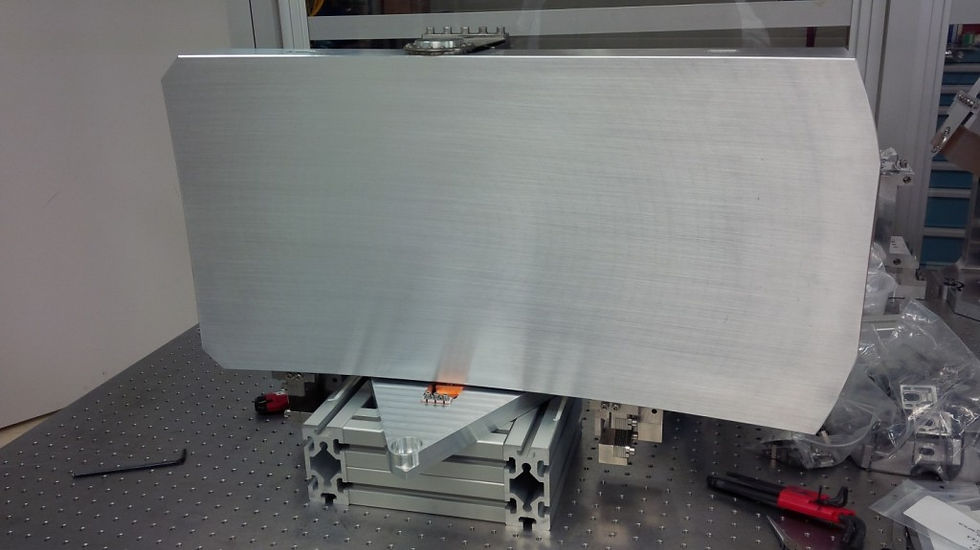

Figure 6 shows the SPIROU optical bench mounted on the G10 thermal isolation legs. The radiation shielding and aluminum multi-layer insulation is visible just below. The aluminum frame structure below the shielding supports the entire opto-mechanical structure that will operate at 80K. The full-sized surrogate parabola (~40kg), fold mirror and grating are utilized to provide mass and fitting confirmation without risking the final optical elements at this point in development.
Figure 7 shows the optical bench covered by the active radiation shield. This shield will be actively controlled to a precision of better than 10 milliKelvin in order to have an acceptably small effect on the optical system due to radiation effects.


With the system almost completely assembled, the next two months will see multiple cool-down cycles to demonstrate reliable operation, tuning of the thermal control system and finalization of the software interfaces.
Figure 8 and Figure 9 show the wrapped thermal critical components being covered up by the moving end of the vacuum vessel for an initial thermal test.


Square Kilometre Array Update
From Bryan Gaensler Canadian SKA Science Director
(Cassiopeia – Spring 2016)
For more information on the SKA, subscribe to the Canadian SKA email list and visit the Canadian SKA WWW site.
International SKA Activities
Canada is one of 10 member countries of the SKA Organisation, and is represented on the SKA Board of Directors by Greg Fahlman (NRC) and Bryan Gaensler (University of Toronto). The Board most recently met in July 2015 (Cape Town) and November 2015 (Jodrell Bank). Notable outcomes from these two meetings included:
Election of a new Board Chair (Giovanni Bignami, Italy) and Vice-Chair (YIN Jun, China)
Discussion of ongoing site characterisation surveys, pre-construction activities, power policies, operations planning, and construction of the SKA headquarters site
Approval of a cost-constrained budget for the SKA Organisation for 2016
Consideration of a revised schedule and baseline design for SKA1
The next SKA Board meeting will be held on April 4-5, 2016 (Pune).
A SKA Data Flow Advisory Panel (DFAP) has now been convened, with Canada represented by Chris Loken from Compute Ontario. DFAP has been charged with advising the SKA Board on how to optimise the data flow system to ensure that science results can be efficiently extracted. So far, the panel has reviewed analyses of estimated science data production rates, global networking costs, potential archive sizes and the computational requirements for data re-processing and science analysis. The panel has also considered operational, resourcing and governance issues associated with implementing a solution centrally or through regional centres. The panel began its work in the fall of 2015 and held a two day face-to-face meeting in March 2016 to draft a final report.
For further information on international SKA activities, see the latest SKA Newsletter and the monthly SKA Organisation Bulletin.
SKA Intergovernmental Organisation (IGO) Progress
Round 2 of the Treaty Negotiations was held in Rome on January 26-28, 2016. Nine countries were at the negotiating table with formal delegations of typically 3 to 5 people, mainly government officials in ministries responsible for science facilities or the like, with representation from ministries of foreign affairs, or equivalent. Canada was invited as an Observer and Greg Fahlman (General Manager, NRC-HAA) and Gilles Joncas (Chair, ACURA Board of Management) attended.
Good progress was made toward finalising the text of the proposed Treaty Convention that will establish the IGO, but much more work needs to be done in key areas, including the financial arrangements, matters of access to the telescope, procurement and intellectual property rights and policies, as well as the nature of the privileges and immunities required by the project to operate globally. Working groups to deal with these issues were established in the Round 1 session in October 2015 and continue their work between the formal plenary sessions. The working group chairs do share developments with the Canadian Observers although we are not formal participants in the working groups themselves.
The subsequent Round 3 is scheduled for April 19-21, 2016, also in Rome. Canada is again invited as an Observer. This was intended to be the final Round with the convention to be “initialed” and sent back to the respective governments for their internal ratification processes. It is possible that this ambitious goal will not be met and that a subsequent Round will be needed before the key elements of the Treaty are initialed by all Parties. The intent remains to finalise the Convention by the end of 2016 or early 2017. Ratification by five parties, including the three Host countries (UK, Australia, RSA), is required to bring the SKA IGO into existence. This is anticipated to happen by early 2018 in order to initiate procurement activities for the subsequent construction phase.
The principle issues for the Canadian Observers are to ensure scientific access to the facility, with opportunities to influence science priorities and to protect the substantial investment made in developing technology that would be applicable to the SKA. The SKA negotiating parties are aware of Canada’s position and conscious of the need to provide alternatives for countries unable to sign the Treaty to maintain engagement in the Project.
SKA Science and Science Engagement
Development of a new Canadian SKA website has recently been completed, and the site is now live. The site is fully bilingual, and is your starting point for all information about Canadian SKA activities.
The SKA project maintains 11 international science working groups and another 2 focus groups. Membership of science working groups and focus groups is open to all qualified astronomers. If you are interested in joining one of these groups, please contact Bryan Gaensler (bgaensler@dunlap.utoronto.ca).
The Murchison Widefield Array (MWA) is one of three designated SKA precursors (i.e., SKA pathfinders on an SKA site), and is the only one of these three currently operational. Australian government funding has now been awarded for MWA phase 2, which will improve the sensitivity of the array by an order of magnitude. The MWA consortium held its annual project meeting and Board meeting in Toronto over Dec 7-9, 2015. The MWA Board decided to admit a Canadian consortium to the MWA project, led by the University of Toronto; the legal process to add this new Canadian partner is now underway. This will provide Canada with one seat on the MWA Board; Bryan Gaensler has been invited to attend Board meetings as an observer until the admission process is complete.
The first of a roughly annual series of SKA-related science meetings for Canadian astronomers was held in Toronto over December 10-11, 2015 (immediately following the MWA project meeting). This was a very successful meeting, attended by 63 astronomers, ionosphericists and industry representatives from Canada, Australia, India, the USA, New Zealand and the United Kingdom. The meeting featured 25 talks, covering the SKA project, Canadian contributions to SKA science and technology, industry participation, SKA pathfinders, and future Canadian involvement in SKA (see ). In the concluding discussion, a plan emerged for a proposal to the CFI Fund, through which we would begin to develop the tools and infrastructure to support a Canadian SKA Data Centre (along with a short-term focus on similar support for VLASS, CHIME and ASKAP). A CFI proposal is now being developed, led by Erik Rosolowsky (Alberta) and Bryan Gaensler (Toronto).
The University of Toronto and the University of Cape Town will jointly host a major conference, “Fundamental Physics with the Square Kilometre Array”, in April 2017 in Mauritius. The goal is to attract the theoretical physics community to the SKA project. Bryan Gaensler (Toronto; chair) and Ingrid Stairs (UBC) are both members of the Scientific Organising Committee for this meeting.
SKA Technology Development
NRC Herzberg continues to be a major participant in pre-construction efforts across several of the SKA design consortia.
NRC has been designated the lead organisation for the Central Signal Processor (CSP) consortium, and is also leading the SKA1-Mid correlator/beamformer. Work is moving forward strongly on the powerMX FPGA platform (code-named Talon), with prototyping activities well underway.
Within the Dish Consortium, the original recommendation proposed for the downselect on the dish structure was to use the NRC rim-supported composite reflectors. However, this recommendation fell short of the 2/3 assent required by the Dish Board, and a new panelised metal reflector design from Germany and China was allowed to compete against the NRC design. A final downselect occurred in November 2015, and the review panel recommended the German/Chinese design over that developed by NRC. This was a surprising decision, and removes NRC from the SKA Dish Structure work. NRC will continue composite reflector research work for higher frequencies, and will support industry interest in commercial reflectors.
NRC continues to lead the Single Pixel Feed digitiser sub-element, passing preliminary design review and preparing to build prototypes in stage 2. The re-baselining addition of Mid band 5 (4.6-13.8 GHz) has added work requiring higher speed samplers to maintain direct conversion. NRC is collaborating with the ALMA high-speed sampler group led by U. Bordeaux, who are developing suitable high-speed samplers. NRC is continuing work on cryogenic low-noise amplifiers for single pixel feeds bands 1 and 2, and has delivered samples to Onsala and EMSS SA, respectively. These same amplifiers have been chosen for MeerKAT, and NRC is in full production with industry partner Nanowave Technologies to deliver MeerKAT bands 1 and 2. NRC will develop prototype band 5 LNAs and submit them for competitive consideration.
Work on phased array feeds (PAFs) is continuing, although the re-baselining decision deleted SKA-Survey and the PAFs from SKA1. NRC is in discussion with CSIRO and ASTRON to form a new advance instrumentation program consortium to continue work on PAFs for SKA. NRC’s L-band PAF was recently equipped with the first room temperature CMOS LNAs from U. Calgary and achieved a hot/cold test system temperature of 20 K. A full prototype to be tested on DVA-1 is being developed. NRC continues to work on cryogenic PAFs, and has moved its concept design to band 4 (2.8-5.2 GHz). A prototype will be produced, again for testing on DVA1.
Within the Telescope Manager (TM) Consortium, NRC is playing a supporting role to NCRA India to develop standards for the local monitor & control software architecture. A standard based on Tango has been developed, and is being ratified for use by all the other consortia.
The SKA’s Science Data Processor (SDP) team is designing the flow of data from the SKA correlator to individual astronomers. A group of Canadian universities and the CADC are working on the SDP design and implementation. The SDP underwent a design review at the beginning of 2015 and the requirements for the SDP are becoming concrete. Regional data centres will be used for the SKA, and discussions are beginning on the path toward establishing a Canadian (North American?) SKA data centre.
ACURA Advisory Council on the SKA
The Association of Canadian Universities for Research in Astronomy (ACURA) coordinates activities and discussion on the SKA through the ACURA Advisory Council on the SKA (AACS). Four new members have been appointed to ACURA for 2016: Gregory Sivakoff (University of Alberta), Samar Safi-Harb (University of Manitoba), Dexter Jagula (SkyWatch) and David Stevens (MacDonald, Dettwiler and Associates). ACURA thanks outgoing AACS members Jeroen Stil, Norbert Bartel, Brian Fry and Don Aldridge for their contributions. A listing of all members of AACS is available.
AACS meets several times per year, with its next meeting on April 21, 2016. For further information or to propose AACS agenda items, please contact the AACS Chair, Bryan Gaensler (bgaensler@dunlap.utoronto.ca).
TMT Update – March 2016
By Ray Carlberg (Cassiopeia – Spring 2016)
TMT planned to have first light in 2017, which would have been wonderful. However, like virtually all major observatories (recall HST, JWST, ALMA) TMT has suffered some (completely novel) bumps in the road. We first lost five years with a funding problem when AURA was removed from the project. Since then we put together a new partnership, collected over a billion dollars and made the decision to release it for construction in April 2015.
The following is my assessment of about where we are, which is largely factual but includes my views of some of the risks and issues that the project must face.
On Dec 2, 2015 the Hawaii Supreme Court (HSC) struck down the Conservation District Use Permit from the Hawaii Board of Land and Natural Resources to the University of Hawaii. TMT itself was not directly involved (the parties were the Board of Land and Natural Resources and the University of Hawaii), although the decision terminates TMT site activity in Hawaii. The HSC identified a process error; in that the permit was granted before a contested case procedure was allowed. The full decision also notes that Conservation Districts have a number of considerations for use and Native Hawaiian consultations that were not clearly followed in the permit process. Independent of the legal situation, the statewide opposition is about 25%, with roughly 60% Native Hawaiians opposed. Canadians would expect to build a major science facility where the local population shares in our excitement of science and views the facility as an item of local pride. Even when TMT had a legal permit, political protest was more than sufficient to prevent site access.
We were invited by a wide ranging group of Hawaiians to consider Mauna Kea as a site. What happened to that support? The concerns about over-use of Mauna Kea arose in the 1990’s and led to the defeat of the Keck outrigger telescope project. A response in Hawaii was to create the Master Plan of 2000, which provided a way forward for astronomy, but at the same time laid out a plan to better regulate the mountain. The MP2000 identified a site for a future giant telescope, which has turned into the TMT site. One aspect of MP2000 is that the TMT site was to be the last site to be developed, leading one US astronomy leader to state that “American astronomy has no long term future in Hawaii”, since in the course of time any astronomy program will inevitably want to build larger, more powerful facilities, which cannot be done under the MP2000. Many, including the Governor of the State, see the Master Plan as not achieving its goals, with Mauna Kea continuing to be over-developed for tourism and insufficient access control. TMT has also become a rallying point for a range of environmental and Native Hawaiian issues, united around stopping TMT. Unless there is a resolution of the Hawaiian situation soon, there will be no support in Canada to continue in Hawaii.
What now? TMT has publicly stated that it plans to restart construction in April 2018 or sooner. To allow the partners to have their resources ready requires that there be a site for which the legal and all other aspects of site access are clearly resolved mid-2017. A good thing is that key Canadian deliverables are not significantly site dependent. We are supplying the enclosure, with Canadian work deliverable items being installed above a base ring and foundation which are costs shared across the project. The Mauna Kea enclosure design can withstand ice-storms and hurricanes, which as a by-product ensure that it can withstand massive earthquakes. The enclosure could be built to the current design and installed almost anywhere. The first light AO system does take into account Mauna Kea atmospheric conditions, but much of what makes AO work is software control which can be modified for a new site.
As of March 1, representatives of the TMT partners have started to travel to various countries and sites that might be suitable sites to host TMT. At the moment this is a fairly wide ranging initiative including sites in both the Northern and Southern hemisphere. Wherever TMT is built it will need to have scientific opportunities that do not simply replicate those available through E-ELT or GMT. Moreover, the decade long delay in getting going means that TMT will need to think carefully about instruments beyond the few initial workhorses to develop powerful competitive instruments that address science, likely in a post-JWST world. So, the good news is that we again have a feasible baseline plan and can be excited about scientific and technical engagement in this great project.
Clearly we would never have selected Hawaii as our preferred site if we had known that we would fail. Given the investment in Hawaii and the many people there who have supported TMT, we need to continue to give Hawaii a chance. It is important to emphasize that a number of people, some associated with TMT, many others in Hawaii, are working hard to help Hawaii be a viable TMT site. However, the pace of activity in Hawaii is not encouraging given our schedule needs. The site permit decision took nearly three months to be remanded back from the courts to the BLNR for them to take action on revising their process to one that could be legally acceptable. Typically the legal steps in getting a permit take about a year, after which the court challenges will start. Although there is ongoing discussion in Hawaii, the opponents remain opposed and are generally believed to have gone from essentially no professional legal support, to potentially very effective and seasoned legal representation. Beyond the law, of course people need to welcome TMT sufficiently that construction can proceed unimpeded. There is also the issue of extending the master lease beyond 2033, which would be essential for TMT and of great interest to a number of other observatories. Some in Hawaii would like to see the summit gradually cleared of all observatories. The Governor’s ten point plan to require that 25% of existing telescopes be removed before TMT is operational is a development that some will see as an encouraging first step in that direction. At the moment the situation does not look all that promising. But, it is not over until it is over and the stakes are fairly high for issues well beyond TMT and astronomy. In the end it is an issue for Hawaiians to solve and they will not be rushed. That is why alternative sites are being assessed with action to be taken soon to maintain schedule.
We very much need to bear in mind that ESO has begun construction of the E-ELT. The ESO finance committee recently approved the procurement of the dome and telescope of the E-ELT, so they are now well on the way. Their plan is to have first light in 2027 under a conservative plan with the existing ESO members. If Brazil joins then they anticipate first light in 2024. GMT continues to move forward with its first light 4 mirror plan (sort-of a double LBT) which gathers a lot more light than an 8m and can do interesting AO work. We need a very good site soon.


Comments