Cassiopeia Newsletter – Summer Solstice 2017

Updated: Aug 22, 2025

DATE: June 20, 2017
In this issue:
President’s Message
Looking Back at the CASCA 2017 Meeting
BRITE Constellation Mission Update
Canadian Gemini News
Report from the CASCA/ACURA TMT Advisory Committee
For a Limited Time Only: Sign Up Now to Participate in New Large Programs at the JCMT!
Report from the LRPIC
MSE Update
NRC Herzberg News
Survey Says…
Using Archived Data in Course Projects: A Call for Collaboration
What Telescopes Do Canadians Use?
Editor: Magdalen Normandeau & Joanne Rosvick
Cassiopeia is CASCA’s quarterly Newsletter, published on or near the solstices and equinoxes (March 21, June 21, September 21 and December 21).
To submit a contribution please email cassiopeia.editors@gmail.com. All submissions must be received by the due date (usually 2 weeks in advance of publication) to be published in the next edition. I accept plain text and Word documents. Note that the formatting of your document will not be preserved. Please include any images as attachments in your email, not embedded in the text. Please include URLs in parentheses next to the word or phrase that you wish to act as link anchors.
President’s Message
By/par Roberto Abraham, CASCA president (Cassiopeia – Summer 2017)

CASCA AGM
Many of us have just returned from a very successful CASCA Annual General Meeting in Edmonton. This was a terrific meeting and we owe our colleagues in Alberta our thanks for putting it together. This year’s CASCA AGM featured some wonderful talks (Dicke’s Superradiance, which I’d not even heard of before the meeting, turns out to be a really interesting thing) and interesting discussion sessions. Several of these sessions focused on topics of great significance for our community, such as the space astronomy funding situation and progress in the construction of the Thirty Meter Telescope. We all look forward to more interesting talks and more stimulating discussion at the 2018 CASCA AGM in Victoria.
CATAC
As I described in my last President’s Message, a major focus of the CASCA Board’s recent activity has been to put into place a formal advisory structure for Canadian participation in the Thirty Meter Telescope project. I’m pleased to be able to report that the CASCA-ACURA TMT Advisory Committee (CATAC) was put into place at the start of this year, and many of you were able to witness it in action at the CASCA AGM. CATAC is being led by Prof. Michael Balogh (Waterloo), and in my opinion he has done an extraordinarily good job managing this new committee.
The specific terms of reference for CATAC are carefully spelled out in a formal document, but the gist is that CATAC has two major roles:
This committee continuously assesses progress in the TMT project, making sure that TMT meets the scientific, technical and strategic goals set out in the Long-range Plan, and it feeds this information to the LRP Implementation Committee.
It acts as a conduit for consulting with and informing the community about the state of the TMT project.
An initial very significant activity of CATAC has been to provide CASCA and ACURA with a detailed assessment of the strengths and weaknesses of constructing TMT on La Palma, in the form of a detailed report. The report is, I think, a model for these kinds of things. It even got written up in Nature! The findings and the recommendations in this report make for important reading and I think you should take a look at it. The high-level summary is that building TMT on Mauna Kea is clearly the preferred option for our community, but building TMT on La Palma would still result in a very exciting telescope that would deliver transformational science for the Canadian astronomical community. Some of the disadvantages of La Palma cannot be overcome (e.g. its lower altitude limits performance at longer mid-infrared wavelengths), but others can be overcome by careful planning and an appropriate funding model. The various trade-offs, strengths and weaknesses in the project are described in detail in the report… please check it out.
By creating CATAC and populating it with astronomers with different areas of expertise, and trying to be inclusive with respect to institutional geography, gender and career stage, CASCA and ACURA have set in place a credible and representative structure for community-based feedback and advice. I think this committee is firing on all cylinders (thanks again, Michael Balogh and everybody serving on CATAC) and it’s really impressive to see it work. CATAC meets frequently (approximately weekly by telecon, though in between there is considerable discussion via email and via the Slack groupware system) and it has succeeded in spreading TMT expertise and engagement over many institutions. In my opinion this aspect of the committee’s activity will have an even more enduring impact than its first report, because the more Canadians get involved in the project, the more they feel a sense of ownership in it, at least if our community’s feelings about CFHT can be taken as a guide. For this reason, I was particularly pleased by CATAC’s decision to open four meetings to CASCA members, via Webex. These open meetings included presentations by key people in the TMT project. Armed with this information, members of the community provided thoughtful advice to CATAC, who discussed this at length and synthesized the community’s feedback into the final report. This activity has already had an impact, with more thinking at the project level now being focused on hardware (such as an adaptive secondary mirror) and operational models (such as an adaptive queue) that are of particular importance to the Canadian community.
Advancing the Long Range Plan
The long description above might give you the impression that the CASCA Board did nothing but focus on TMT this year. This is far from true! We were kept busy by many other things. For example, the federal government solicited feedback from us on a number of matters of relevance to the astronomical community, and CASCA, acting in partnership with ACURA and Industry as part of the Coalition for Canadian Astronomy, responded in the following ways:
The Coalition provided written input to Canada’s Innovation Agenda, and to the federal government’s Fundamental Science Review Panel. The Coalition also provided a pre-budget submission the federal government, noting the commitment needed to fulfil the aspirations in the Long Range Plan.
On behalf of the Coalition, I met with the Fundamental Science Review Panel in Calgary. Once again, the emphasis was on the items in the Long Range Plan.
Last Fall, the Coalition mailed out a summary of the conclusions of the CASCA Mid-Term Review to all MPs. This Spring we sent each MP a beautifully-printed copy of the full review.
In addition to providing feedback to specific requests from the government, we also acted in a pro-active manner in a number of ways. For example:
On behalf of the Coalition, I flew to Ottawa to meet with representatives from the Aerospace Industry Association of Canada to consider ways in which CASCA could partner with them on topics of mutual interest.
On May 9 the coalition co-chairs (Don Brooks, Guy Nelson and I) traveled to Ottawa and met with Genevieve Tanguay (VP, Emerging Technologies, NRC), John Burnett (Director of Policy, Office of the Minister of Science), and Marilyn Gladu (Conservative Party Science Critic).
These latter meetings were particularly useful, not only for informing government about our aspirations in the LRP, but also for hearing back from them about ways we could better align ourselves with top-level national goals (an important component in our success). For example, in our discussions with NRC we discussed challenges to do with Compute Canada and the Canada Foundation for Innovation (which has not clearly understood the close linkage between University-based and NRC-based researchers), and we learned that NRC needs help with outreach and public communications. I think that CASCA members should try hard during our outreach activities to communicate how success in Canadian astronomy is at least partially a function of a close partnership between NRC, Universities, and Industry. I hope you can help by touching upon this theme when describing our activities to the general public.
In the coming months the CASCA Board and its various committees will continue to work hard on your behalf. There are a few big-ticket items coming up, and I expect we will be focusing considerable energy on advocacy for the space astronomy and radio astronomy portions of the Long Range Plan, and on a professional climate survey being prepared by the Equity and Inclusivity Committee.
Let me conclude by apologizing yet again for a somewhat overlong President’s Message, and on behalf of the CASCA Board, I extend to you our very best wishes for a healthy, happy, and productive summer.
Looking Back at CASCA-2017
By Erik Rosolowsky, on behalf of the LOC (Cassiopeia – Summer2017)
The astrophysics group at the University of Alberta was pleased to host the 2017 Annual General Meeting of the Canadian Astronomical Society. The meeting was held in Edmonton, Alberta from May 29 to June 1, 2017, and over 200 members of the Canadian astronomical community attended. The full details of the meeting, including the conference program remain available at casca2017.ca. In addition to several prize lectures by the 2017 CASCA awardees, invited speakers covered topics ranging from engaging public outreach, to planetary energy budgets, to next generation instruments. Over 70 junior researchers presented their research in poster and oral contributions, showcasing the next great results to come out of the community. Fiona Harrison, Principal Investigator of the NuSTAR mission, delivered the Helen Sawyer Hogg lecture to meeting attendees and the public on “From Spinning Black Holes to Exploding Stars: A New View of the High Energy Universe.”
Several additional activities happened associated with the CASCA meeting including a full-day workshop for graduate students, this year focusing on writing scientific papers. In addition to faculty members, the graduate students heard from Leslie Sage, editor at Nature (and CASCA press officer), who spoke about the publication process, and Christina Hwang of the University of Alberta libraries, who spoke about data access and management. The Education and Public Outreach Committee organized an excellent workshop for local educators, expanding and enriching their ongoing effort to connect our community with the science educators. There were two special sessions to present information about Canadian participation in Very Large Optical Telescopes, in particular the Thirty Metre Telescope. These sessions featured broad-ranging discussion about the circumstances surrounding our next great telescope project. The CASCA Board, the Joint Committee on Space Astronomy, and the Association of Canadian Universities for Research in Astronomy, all held their annual face-to-face meetings.
In addition to oral and poster prizes presented to the students in attendance, the LOC initiated a hopefully-continuing tradition of awarding a poster prize to the best post-PhD contributor. At this meeting, the SOC/LOC prioritized junior scientists for oral contributions and we instituted the prize to encourage senior scientists to present their research through a poster presentation. This year’s inaugural winner was Jason Rowe (Montréal/Bishop’s).
Awards for students were presented to:
Best student oral presentation (as judged by the Board): (tie) Gwendolyn Eadie (McMaster) & Anna Ordog (Calgary)
Best student poster presentation (as judged by the Board): Megan Tannock (Western)
Best student oral presentation (as judged by the students): Gwendolyn Eadie (McMaster)
Best student poster presentation (as judged by the students): Farbod Jahandar (Victoria)
We would like to thank attendees for coming to the meeting. Your attendance is ultimately what makes these annual meetings a success. In particular, we would like to thank those members of the community who support their students to travel to and attend CASCA meetings. By convening and deliberating on scientific and policy questions, we strengthen our community and advance our broader scientific goals.
BRITE Constellation Mission Update
By Gregg Wade, Canadian PI for BRITE (Cassiopeia – Summer 2017)

BRITE-Constellation is an international space astronomy mission consisting of a fleet of 20x20x20 cm nanosatellites dedicated to precision optical photometry of bright stars in two photometric colours. The mission continues in full science operations, with 17 data releases to BRITE target PIs having already taken place, and many datasets available in the public domain from the BRITE public archive.
The most recent Call for Proposals closed on 01 December 2016, and 15 new proposals for observation were evaluated.
More information about the mission is available on our website: www.brite-constellation.at. General inquiries about BRITE Constellation should be directed to the BEST Chair, Andrzej Pigulski, Univ. Wroclaw, Poland: pigulski@astro.uni.wroc.pl or to Canadian PI Gregg Wade, RMC: wade-g@rmc.ca.
Operations
There are five operating BRITE satellites in the Constellation, collecting data on various sky fields in a coordinated programme to obtain well-sampled, longterm continuous (~6 months) light curves in both red and blue bandpasses.
As this issue of Cassiopeia went to press, here was the status of the sky assignments for the BRITE cubesats:
BRITE Toronto (Canada): Toronto observes with a red filter. It continues observing the Vel/Pic field after a record-breaking 215 days-long run. It is also observing the Ara/Sco field.
BRITE Lem (Poland): Lem observes with a blue filter. It is also observing the Vel/Pic field, along with the Sagittarius III field.
BRITE Heweliusz (Poland): Heweliusz observes with a red filter. This satellite is observing the Carina field.
UniBRITE (Austria): UniBRITE observes with a red filter. It is also observing the Sagittarius III field.
BRITE Austria (Austria): BRITE Austria observes with a blue filter. It is also observing the Sagittarius III field.
The BRITE Constellation observing programme from early 2017 through early 2019 has been planned by the BRITE Executive Science Team (BEST), and details are available on the BRITE photometry Wiki page.
Recent science results and technical papers
“Studying the photometric and spectroscopic variability of the magnetic hot supergiant zeta Orionis Aa” (Buysschaert et al. 2017, A&A, in press):To understand the variability of evolved massive stars in more detail, Buysschaert et al. present a study of the O9.2Ib supergiant zeta Ori Aa, the only currently confirmed hot supergiant to host a magnetic field. They perform a detailed frequency analysis to detect and characterize the star’s periodic variability, detecting two significant, independent frequencies, their higher harmonics, and combination frequencies. We confirm the variability with P_rot/4, likely caused by surface inhomogeneities, being the possible photospheric drivers of the discrete absorption components. No stellar pulsations were detected in the data.
“Triple system HD 201433 with a SPB star component seen by BRITE-Constellation: Pulsation, differential rotation, and angular momentum transfer” (Kallinger et al. 2017, A&A, in press):The SPB star HD 201433 is known to be part of a single-lined spectroscopic triple system, with two low-mass companions orbiting with periods of about 3.3 and 154 d. Kallinger et al. identify a sequence of 9 rotationally split dipole modes in the photometric time series and establish that HD 201433 is in principle a solid-body rotator with a very long rotation period. Tidal interaction with the inner companion has, however, significantly accelerated the spin of the surface layers by a factor of approximately one hundred. The angular momentum transfer onto the surface of HD201433 is also reflected by the statistically significant decrease of the orbital period of about 0.9 s during the last 96 years. Ultimately, the authors conclude that tidal interactions between the central SPB star and its inner companion have almost circularised the orbit but not yet aligned all spins of the system and have just begun to synchronise rotation.

“BRITE-Constellation: Data processing and photometry” (Popowicz et al. 2017, A&A, in press):The main aim of this third fundamental technical paper about BRITE-Constellation data is the presentation of procedures used to obtain high-precision photometry from a series of images acquired by the BRITE satellites in two modes of observing, stare and chopping. Popowicz et al. describe two pipelines corresponding to the two modes of observing. The assessment of the performance of both pipelines is presented. It is based on two comparisons, which use data from six runs of the UniBRITE satellite: (i) comparison of photometry obtained by both pipelines on the same data, which were partly affected by charge transfer inefficiency (CTI), (ii) comparison of real scatter with theoretical expectations. It is shown that for CTI-affected observations, the chopping pipeline provides much better photometry than the other pipeline. For other observations, the results are comparable only for data obtained shortly after switching to chopping mode. Starting from about 2.5 years in orbit, the chopping mode of observing provides significantly better photometry for UniBRITE data than the stare mode. This paper shows that high-precision space photometry with low-cost nano-satellites is achievable. The proposed methods, used to obtain photometry from images affected by high impulsive noise, can be applied to data from other space missions or even to data acquired from ground-based observations.

Conferences, resources and social media
Conferences
The 3rd BRITE Constellation Science Conference will be hosted in Canada in August 2017. The conference, entitled “New scientific and technical achievements with BRITE”, will take place at the Auberge du Lac Taureau, located 2.5h north of Montréal, from 6-10 August. Late registration may still be possible by contacting brite2017@astro.umontreal.ca.
Resources
The BRITE Public Data Archive, based in Warsaw, Poland, at the Nikolaus Copernicus Astronomical Center, can be accessed at brite.camk.edu.pl/pub/index.html
The mission Wiki (including information on past, current and future fields) can be accessed at brite.craq-astro.ca/
BRITE Constellation is now on Facebook, at @briteconstellation
The BRITE International Advisory Science Team
The BRITE International Advisory Science Team (BIAST), which consists of BRITE scientific PIs, technical authorities, amateur astronomers, and mission fans, advises the mission executive on scientific and outreach aspects of the mission. If you’re interested to join BIAST, contact Canadian BRITE PI Gregg Wade: wade-g@rmc.ca.
Canadian Gemini News
By Stéphanie Côté (NRC Herzberg) (Cassiopeia – Summer 2017)
Laura Ferrarese Interim Director of Gemini!
Markus Kissler-Patig, current Gemini Director, will be stepping down in July, to return to ESO. Markus’s remarkable leadership has brought many new ideas and initiatives to Gemini during his 5-years term, and we will dearly miss him. We were happy to learn that none other than astronomer extraordinaire Laura Ferrarese from NRC-Herzberg will be taking the helm of Gemini as Interim Director for a one-year term! She will be serving in Hilo while an international search is underway for a new permanent Director. See the Gemini press release here. We are delighted to see Gemini in very capable Canadian hands in the year to come.
New Next Instrument announced: introducing OCTOCAM!
The next instrument to be built as a facility instrument for Gemini has been selected, it will be OCTOCAM. The PI is Antonio de Ugarte Postigo (IAA) with co-PI Pete Roming (Southwest Research Institute). It is an 8-channel imager and spectrograph that will simultaneously observe the g, r, i, z, Y, J, H, and Ks bands in a square field-of-view of 3’x3′, or a circular one with a diameter of 4.24′. It can also do long slit (3′ long) spectroscopy with a resolution of R ~ 4,000, simultaneously covering the range between 0.37 – 2.35 microns.
The eight independent arms in OCTOCAM allow the user to adjust exposure times in each bandpass for increased efficiency and the best match to observing conditions. By using state of the art detectors – frame transfer in the optical and CMOS (complementary metal-oxide semiconductor) in the near infrared – OCTOCAM will have negligible readout times enabling high time-resolution observations (< 50 ms for a 30x30 pixel window). This temporal resolution will open up a new region of observation space.

Maunakea Dunlap Summer School students get VIP visit to Gemini
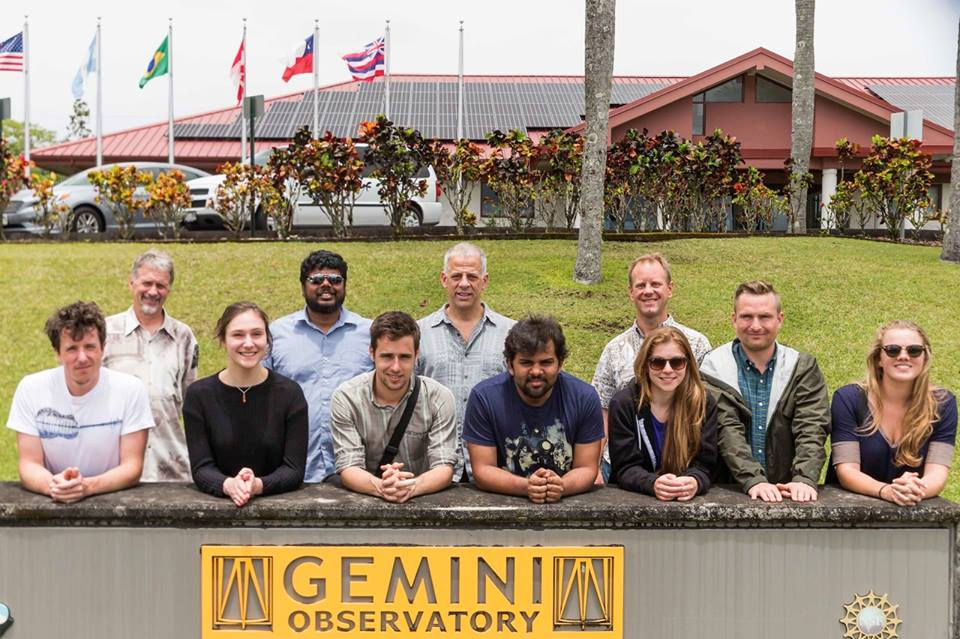
In order to insure that our Canadian observatories keep their leadership position, making Canadian research shine in tomorrow’s astronomical world, the contribution and training of young Canadian astronomers must be fostered through continued interactions. The Maunakea Dunlap Graduate School (MKDS) aims to expose Canadian astronomy graduate students to world-class instrumentation on site where they can participate in observations and data acquisition and processing, learn about the latest instrumentation, and interact with scientific and technical staff. Seven students from various Canadian universities participated in the 2017 MKDS last May, spending 10 days at the Gemini and CFHT headquarters and visiting various Maunakea Observatories, including the Gemini Northʻs Hilo Base Facility (HBF) and Gemini North’s summit telescope facility. At Gemini, students attended lectures by Gemini astronomers Laure Catala, André-Nicolas Chené, Inger Jorgensen, and Meg Schwamb who shared highlights on Geminiʻs recent science and instrumentation news. Students also acquired data using GMOS (under 0.5″ seeing!) and received instructions about data reduction. Similar equally successful and rewarding activities took place at CFHT. In addition to visiting and using CFHT and Gemini, students were able to visit the JCMT, Keck, and Subaru telescopes. This project is led by Prof. Stéphane Courteau at Queen’s University and Prof. Suresh Sivanandam at the Dunlap Institute. Canadian students wanting to participate in future MKDS must first attend the Dunlap Summer School on Astronomical Instrumentation.
Recent Canadian Gemini Press Releases
At the January 2017 AAS a team lead by Shriharsh Tendulkar (McGill) and including Victoria Kaspi (McGill) and Paul Scholz (NRC) presented the first optical follow-up of a Fast Radio Burst. Fast radio bursts (FRBs) are bright (~ Jy) and short (~ ms) bursts of radio emission, of which 18 have been detected over the past 10 years, but that had remained so far of unknown origin. FR121102 is the only repeat FRB for which it was then possible to get an accurate position (of 100 mas precision) thanks to VLA follow-up. Gemini then provided the crucial rapid follow-up to produce the first optical imaging and spectroscopy of a FRB. The Gemini data revealed that the FRB host is a small unassuming dwarf galaxy at z = 0.19, with a diameter of < 4 kpc and about 1% the mass of the Milky Way. This was surprising as it was assumed so far that most FRBs would come from large galaxies with more neutron stars (the top candidates to explain FRBs). This hints that FRBs may rather be linked to long-duration gamma-ray bursts and superluminous supernovae which frequently occur in dwarf galaxies. The paper published in ApJ is available here.

Figure 3 -Gemini composite image of the field around FRB 121102 (indicated). The dwarf host galaxy was imaged, and spectroscopy performed, using GMOS on the Gemini North telescope. Image Credit: Gemini Observatory/AURA/NSF/NRC In April an international team led by Wesley Fraser (Queen’s University, Belfast, UK) and including Brett Gladman (UBC), JJ Kavellars and Stephen Gwyn (NRC) had a press release with results from Gemini Large and Long Program “Colours of the Outer Solar System Object Survey” (Col-OSSOS). They studied a small population of blue-colored loosely-bound pairs of planetoids, hiding amongst the mainly red-colored Cold Classical Kuiper Belt objects. While the red CCKBOs are thought to have formed in their current location in the middle of the Kuiper Belt, this study suggests that the blue binaries actually formed in a region much closer to the Sun, and were then pushed out to their current location. This research indicates that when Neptune moved from 20 AU to its current location at 30 AU, several billions of years ago, this was a very slow and calm movement, which allowed the fragile and loosely bound binaries to be swept out a similar distance to where they are found currently without being disrupted into two separate single objects. The Nature Astronomy paper is available here.
Join the thousands and thousands of Gemini Observatory followers on Facebook https://www.facebook.com/GeminiObservatory and Twitter @GeminiObs
Report from the CASCA/ACURA TMT Advisory Committee
By Michael Balogh (CATAC Chair) (Cassiopeia – Summer 2017)
CATAC’s first report to ACURA and CASCA has been made publicly available online. This report is the result of broad consultation with the community, members of the TMT project office, experts in adaptive optics, site testing and computational fluid dynamics, and Directors and users of telescopes on the Canary Islands. The report includes a quantitative comparison of the capabilities of TMT on its preferred site on Maunakea (MK13N), relative to the alternative site (Observatorio del Roque de los Muchachos, ORM) and the other 30-m class facilities under development: ELT and GMT. In summary we find that TMT is most capable and competitive if it can be constructed as planned on MK13N. However, if it proves necessary to move to ORM, TMT will still deliver transformative science that will meet the needs of the majority of the Canadian community. We made the following specific recommendations, which are worth repeating here:
Given that ELT will be located at a better site, with a substantial aperture advantage, competitiveness now and in the future for TMT will require extracting the maximum from instrumentation and operations. Innovation will be of fundamental importance. A robust development budget with stable funding commitments is also essential. Operations must include an adaptive queue, and should allow observing flexibility. Canadian participation in a VLOT that fails to meet these basic national facility requirements should not be considered.
TMT@MK13N offers significant competitive advantages relative to ELT. In particular it is expected to outperform ELT in the UV and MIR, while remaining competitive for visible and NIR observations. Therefore the site on MK should not be given up prematurely. The decision to move to ORM should only be made once it is clear that construction on MK will delay the project significantly relative to ELT, or fail to attract the necessary funding. As both the realistic timeline for ELT and the funding opportunities for TMT remain uncertain, we should proceed with caution.
The broader Canadian community should be engaged in a project to which we are dedicating so many resources. We should aim to have ~5 Canadians on each science team. They should be representative in terms of geography, institution, gender, and career stage. While all Canadian researchers are encouraged to apply, CATAC (or LRPIC) should also develop a list of specific individuals to approach to apply for ISDT membership well before the next call (January 2018). LRPIC should investigate whether there exist mechanisms within the Canadian funding ecosystem to support ISDT activities, or whether a new allocation should be sought, perhaps by ACURA.
We presented a summary of our findings at this year’s CASCA meeting in Edmonton. From the ensuing discussions (during both the CATAC lunch meeting and the LRPIC/CATAC meeting the following morning) we took away the following:
The community remains strongly supportive of TMT on Maunakea. A move to ORM would generally be disappointing. However, when asked directly, no one stated that they would be unable to achieve significant scientific progress with TMT if it were located on ORM. This is strong affirmation that the alternative site will be acceptable to the Canadian community.
The community is dissatisfied with the TMT project’s transparency regarding its financial planning and overall viability. Little or no information about how the Board is dealing with the financial shortfall is available, and this lack of communication has resulted in some skepticism in the community regarding the project’s ability to complete construction.
The Canadian astronomical community is aware of the conflicting interests on Maunakea, and respects the legal process that is being undertaken in Hawai’i. There is an understandable desire to act ethically.
CATAC agrees that the TMT project office and Board need to be more forthright in their communications with the community. To encourage this, we would like to hold our next public Webex meeting on the financial status of the project, and we will invite one or more representatives of the project to lead with a presentation and be available for following discussion.
Finally, we would like to thank and congratulate those of you who answered our call to participate in the International Science Development Teams. As of this writing, 18 individuals have responded to fill 23 positions (with five individuals serving on more than one ISDT). Including those already participating, we anticipate at least 35 ISDT positions filled by 28 Canadians. This is a great improvement and a better reflection of what this telescope means to our community.
The TMT Science Forum is being held in Mysore, India on November 7-9, 2017. We would like to encourage especially those participating in the ISDTs to consider attending. We are still working on identifying sources of partial financial support, but now recognize that may not be possible before this meeting. We hope many of you will still be able to attend.
As always, CATAC is happy to hear from you at any time. Please email mbalogh@uwaterloo.ca if you have questions for us, opinions or advice relevant to our mandate, or indeed information that you think might be useful to CATAC. Our website is now hosted on the CASCA site and we will keep this updated with upcoming meetings, events and documents.
CATAC Members:
Michael Balogh (University of Waterloo) Chair
Sarah Gallagher (Western University), Vice-Chair
Stefi Baum (University of Manitoba)
Chris Wilson (McMaster University)
David Lafrenière (Université de Montréal)
Harvey Richer (UBC)
Observers:
Greg Fahlman (General Manager of NRC-HAA, non-voting, ex-officio)
Don Brooks (Executive Director of ACURA, non-voting, ex-officio)
Bob Abraham (CASCA President, non-voting, ex-officio)
Doug Welch, (Science Governor for Canada on TIO Governing Board, non-voting, ex-officio)
Tim Davidge (NRC)
Luc Simard (NRC)
For a Limited Time Only: Sign up now to participate in new large programs at the JCMT!
From/de Chris Wilson(Cassiopeia – Summer 2017)
The results of the second round of Large Programs on the JCMT have been announced! This time large nine programs were awarded JCMT time (you can see the list with links to the program web pages here):
BISTRO-2: an extension to the BISTRO program
CHIMPS2: Resolving Star Formation in the Galactic Plane with HARP
NESS: The Nearby Evolved Star Survey
HASHTAG: HARP and SCUBA-2 High-Resolution Terahertz Andromeda Galaxy Survey
JINGLE II: the ISM of starbursts and green valley galaxies
NEP: Extragalactic JCMT Survey of the North Ecliptic Pole
eS2COSMOS: Extending an EAO SCUBA-2 survey to unveil the COSMOS field
S2LXS: SCUBA-2 Large eXtragalactic Survey
STUDIES-SXDS: A second pointing for the SCUBA-2 Ultra Deep Imaging EAO survey
For specific details of each program including the number of hours awarded per weather band and instrument requested please click here.
The JCMT will hold a period of open enrolment that will open soon and will close on 1st August 2017. Astronomers from any Canadian institution who are interested in the science of one or more large programs are welcome to join during this open enrolment period. Please keep an eye on the JCMT website for instructions on how to enroll or feel free to contact Chris Wilson at McMaster for more information.
In other news, Canadian participation in the JCMT has been secured for a further two years (covering the period February 1, 2017 to January 31, 2019) thanks to an award from NSERC’s RTI Operation and Maintenance Support program (PI: C. Wilson) as well as continuing financial contributions from McMaster University, the University of Alberta, and the University of Waterloo. The Canadian community also continues to receive additional credit for observing time in the PI queue thanks to the continued hosting of the JCMT archive at the CADC.
So, consider joining one of the new large programs, and polish up your PI science for the next call for JCMT proposals, which will be due in mid-September.

Report from LRPIC
From John Hutchings (Cassiopeia – Summer 2017)
The LRP has a number of challenges at present, arising from different events and situations. We will continue to engage the community on these matters as they evolve.
TMT
The CATAC advisory committee has been very active and their report is also in this issue. The LRPIC has focussed more on alternatives to TMT should it no longer be a viable large telescope for Canada. This and related matters are in open discussion on the LRPIC-discuss mailing list, and there has been an open webex discussion and a plenary session at CASCA to give the community opportunities to be involved. The possibility of joining ESO has been the principal focus of these, although possible, but unspecified, collaboration between TMT and GMT has been in the background. At this point, LRPIC considers that the ESO alternative is risky in terms of government funding and approval, as well as being a major change in all our operations that may be unwieldy. Thus, as long as TMT proceeds with construction next year, at either site, we remain committed to it, with strong preference for the Hawaii site, if it is possible. However, major funding issues and solutions need more clarification to keep the confidence of the community.
SKA
The project has been undergoing a significant cost-saving exercise to keep SKA1 within the agreed budget. Ongoing concerns are that key science capability be retained, how Canadian partnership may be negotiated in the new IGO structure, and that Canadian contributions be agreed that enable our desired share of about 6%. A workshop to discuss these, and other radio facilities for the future, is to be held at McGill on September 13-14.
MSE
The design process is proceeding well and should be complete by the end of the calendar year. The challenges ahead include funding by all partners, and clarity on the future of MaunaKea for this and other telescopes.
CSA
The CSA budget currently is unable to support the LRP plans for WFIRST, CASTOR, SPICA, LiteBIRD, and Athena, and of course, any new opportunities that may arise in the next decade. This is a result of space science funding and priority having been badly eroded over the past years, with resources almost entirely dedicated to ISS and Radarsat. This dire overall situation is the subject of lobbying via the Coalition, input to the newly appointed Space Advisory Board, and a `white paper’ prepared by several members of the astronomy community. LRPIC is also participating in these initiatives.
Good news
This includes the expected completion, and early science commissioning of CHIME at DRAO this summer, the funding of access to JCMT by NSERC, and the beginning of construction of CCAT-prime, with expected Canadian partnership. We are following the future evolution of Gemini and possible links to Subaru, which are currently in play.
Maunakea Spectroscopic Explorer (MSE) Update

By/par Patrick Hall, MSE Management Group Member (Cassiopeia – Summer 2017)
As discussed at the CASCA meeting, the Maunakea Spectroscopic Explorer (MSE) project has just wrapped up a series of subsystem conceptual design reviews.
Video of the Telescope Structure Conceptual Design
The conceptual design for MSE’s telescope structure by the Spanish firm IDOM has passed its review with flying colours. The 11.25m aperture MSE will fit within a structure only slightly wider than currently exists at CFHT. Details and a video of IDOM’s mount for MSE are available at this link.
More Conceptual Design Reviews
Many MSE partners and work packages delivered conceptual designs for review in Waimea and elsewhere this quarter:
Enclosure (Empire Dynamic Structures), held in Port Coquitlam, BC.
High Resolution Spectrograph (NIAOT, Nanjing). The Project Office welcomed the NIAOT team, including the Director of NIAOT, for this 2 day review.
Fiber Positioning Systems (a competitive study between teams from AAO, UAM and USTC).
Fiber Transport System (Herzberg Institute together with Fibertech Optica, Canada).
Real Time Software Architecture (staff at CFHT).
Top-End Assembly (INSU-DT and GEPI, France).
Low Resolution Spectrographs (CRAL, France) in Lyon, France.
With the completion of the subsystem conceptual design reviews, the next step is to undertake a project-wide system conceptual design review and then a cost review. The Project Office staff are now shifting gears from reviewing designs to preparing material for review, and plan to defend the system design in the last quarter of 2017.
Other Activities
The MSE Management Group held its 2017Q1 meeting by telecon. The components of a Design Phase Master Agreement are under discussion. Such an agreement would spell out past and planned pre-construction contributions from each partner and the corresponding science return in terms of access to MSE survey data as compensation for those contributions.
Canadian astronomers with questions or comments about MSE or MSE governance can contact their MSE MG members, Greg Fahlman and Pat Hall).
The MSE Science Advisory Group began the year by reviewing the MSE Science Requirements Document and prioritizing the first light science capabilities for a nominal 2026 first light. The results of this discussion by the SAG will inform the prioritization of different system elements in the upcoming project-wide system conceptual design and cost reviews.
Canadian astronomers with scientific questions or comments about MSE can contact their MSE SAG members, Kim Venn and Sarah Gallagher.
NRC Herzberg News
From Dennis Crabtree (NRC-Herzberg) With contributions from Chris Willott (Cassiopeia – Summer 2017)
These reports will appear in each issue of E-Cass with the goal of informing the Canadian astronomical community on the activities at NRC Herzberg.
Feedback is welcome from community members about how NRC Herzberg is doing in fulfilling our mandate to “operate and administer any astronomical observatories established or maintained by the Government of Canada” (NRC Act).
Canadian Time Allocation Committee (CanTAC)
CanTAC met in May to discuss and rank CFHT and Gemini proposals for semester 2017B. The meeting was hosted by Stanimir Metchev at Western. The CanTAC SuperChair for this meeting was Ingrid Starirs (UBC), while the Galactic panel chair was Stanimir Metchev (Western) and the Extragalactic panel chair was Eric Steinbring (NRC Herzberg). Dennis Crabtree continues to serve as the technical secretary.
The full list of CanTAC members for the May meeting was:
Galactic | Extragalactic |
Laurent Drissen (Laval) | Peter Capak (Caltech) |
Christopher Johns-Krull (Rice) | Pat Cote (NRC) |
Stanimir Metchev (Western) | Julie Hlavacek-Larrondo (Montreal) |
Els Peeters (Western) | Adam Muzzin (York) |
Leslie Rogers (Chicago) | Eric Steinbring (NRC) |
Samar Safi-Harb (Manitoba) | Ludo van Waerbake (UBC) |
For Semester 2017B CanTAC received 27 CFHT proposals (17 Galactic and 10 Extragalactic) and 36 Gemini proposals (21 Galactic and 15 Extragalactic). The subscription rates were 2.41 for CFHT, 1.91 for Gemini North and 1.90 for Gemini South.
NRC Herzberg commissioned a study of gender systematics in CanTAC grades. CFHT and Gemini proposal grades over 10 recent proposal cycles were analyzed by a social sciences PhD student at Queens under the supervision of Kristine Spekkens. The analysis shows that except for faculty principal investigators (PIs), proposals submitted by female PIs were rated significantly worse than those submitted by male PIs.
To address this issue we will be changing the format of Gemini and CFHT proposals. In the future, all investigators will be listed alphabetically and the PI will not be identified.
JWST Update
This summer the James Webb Space Telescope will undergo its final cryo-vacuum test at Johnson Space Center, Houston. The telescope, including the science instrument module, will be subjected to a range of thermal and optical tests. This 93 day long test program will verify models and performance specifications to ensure that the telescope performs as designed.
At the same time astronomers across the globe are gearing up to prepare JWST science programs. The Director’s Discretionary Early Release Science (DD-ERS) program will use about 500 hours of time early in Cycle 1 to provide example science use cases of a range of instrument modes. This data will have zero proprietary time so prospective users will be well informed of instrument capabilities in advance of the Cycle 2 Call for proposals. The Cycle 1 General Observer Call for proposals is due for release in November this year. This is a significant milestone for the community as they plan proposed JWST observations.

There are many ways to prepare yourself for writing JWST proposals. The Space Telescope Science Institute (STScI) has extensive and increasing documentation. Also available are a set of observation planning tools including the Astronomer’s Proposal Tool (APT), Exposure Time Calculator (ETC) and target visibility tools. This fall the Canadian JWST team, led by PI Rene Doyon, will organise several events aimed at Canadian JWST users including university visits and webinars. The recent announcement at the CASCA meeting in Edmonton of science support funding for JWST users from the Canadian Space Agency is very welcome and will allow the Canadian community to get the most science out of our national investment in the facility.
JWST will be launched into a halo orbit around L2 on an Ariane V rocket in October 2018.
Survey says…
By Magdalen Normandeau (Cassiopeia co-editor) (Cassiopeia – Summer 2017)
“Is anyone going to read this?” That’s what I asked myself as I pulled together a recent edition of the Cassiopeia. It seemed like an important question to ask about a newsletter. When it was first created, the purpose of Cassiopeia was clear: without the web or email, the hardcopy newsletter that members received a few times per year was an important tool for keeping the CASCA community in the loop about observatories, instruments, big projects, etc. Now, however, there’s email and a web page in addition to the newsletter, so does the Cassiopeia still serve a purpose?

When asked what the purpose of Cassiopeia is or should be, many CASCA members referred to community (the Canadian astronomy community, the CASCA community). For example, one survey respondent wrote “To relay news from the community to the community,” while another contributed “créer un esprit de communauté pan canadien.” One senior member of CASCA wrote: “I lived thru the pre-CASCA wars. Never let that kind of situation develop again. The newsletter has been a successful unifying factor.”
The majority (67%) of those who responded to the survey in April 2017 indicated that CASCA should continue to publish Cassiopeia, while only 11% said that Cassiopeia should be discontinued. However, most CASCA members did not choose to complete the survey: 139 surveys submitted – 119 in English and 20 in French. In other words, roughly a quarter of CASCA members were sufficiently interested to complete the survey. Thirty-one other people began the survey but did not get past the third question. Of those who completed the survey, 57% work or study at a university with opportunities for graduate work in astronomy and 23% work for a governmental agency (NRC, CSA). At 26.5%, mid-career people made up the greatest proportion of respondents from academia, followed by late career at 19.7% and emeritus at 14.5%. Only 6 graduate students and 7 postdocs chose to complete the survey, suggesting a lack of interest in CASCA affairs among the younger members.
While 69% of respondents were likely or very likely to read the titles in the announcement email for a new edition of Cassiopeia, only 57% were likely or very likely to follow through to look at the web actual newsletter. This corresponds to approximately 18% of CASCA members. Reasons given for being unlikely to read Cassiopeia include lack of time/feeling overwhelmed (22), information being available from other sources (13), lack of interest (8) and aspects related to presentation or format (8).
Types of articles
A list of types of articles that recently appeared in Cassiopeia was given for consideration. In retrospect, when designing the survey, it would have been more useful to have 3 categories for instruments/observatories instead of specifying instruments: 1) operational, 2) under development, 3) proposed. Hindsight is a wonderful thing. Be that as it may, the results are presented in the figure below. Only for the LRP updates and the message from the president did more than 50% of respondents indicate that they were likely or very likely to completely read the article.

Members were also asked what they would like to read. The figure below shows the responses for the list of possibilities presented. More than 50% of respondents expressed interest in articles about statistics related to astronomy in Canada, award announcements, reports from the Ground-Based Astronomy Committee and from the Joint Committee on Space Astronomy, as well as conference announcements.

In addition to the options listed, several suggestions were made. These mostly fell into 3 categories: 1) the business of astronomy (astronomy & politics ; NSERC ; grant policies & implementations ; CASCA Board agenda & major outcomes), 2) research (research-oriented articles; papers published in previous quarter ; summaries of current Canadian astronomy research accomplishments ; progress reports of major research efforts), 3) people (news on new staff, new PDF hires ; profiles of astronomers in the news ; what has become of…? ; obituaries).
Redundancy and format
Given the multiple means of communication at CASCA’s disposal (email, web site, newsletter), members were asked if they considered redundancy between emailed information and Cassiopeia to be desirable. The answers shown in the figure on the right suggest that while most CASCA members consider repetition of information acceptable, many would appreciate it if articles in Cassiopeia were written as proper articles, not simply direct repetitions of email messages.
When asked about the importance of images in articles, only 19.5% of respondents indicated that they were not important. On the matter of whether or not photos of authors should be included, most were indifferent.
In the comments related to format, 5 people stated that they would like to have a PDF version of the newsletter so that they could read it offline, 4 stated that they would prefer one continuous post rather than each article being a separate post linked to a table of contents, and 2 people suggested that the email announcement for the newsletter could be in a format similar to that used by NRAO, i.e. all articles titles would be listed in the email, with each title linked to its article, and perhaps the first few lines of each article would appear in the email as well. The latter suggestion is relatively easy to implement if the editors send emails directly to the list rather than submitting the announcement via the CASCA webpage where it is not possible to include hyperlinks.

Language
Currently, articles in Cassiopeia are published in the language in which they are submitted. Most are submitted only in English, with a few being submitted in both languages (NRC-Herzberg, CSA, Gemini). No articles in French only have been submitted in recent years. There would be logistical challenges to having the entire newsletter translated: the deadline would need to be a few weeks before publication rather than a few days, and the cost would probably be $1000 per edition (it might be more: I haven’t done a word-count or updated my awareness of the going rate for translation in quite a while). However, it is important to consider the matter as the predominance of English may be a barrier to participation for some CASCA members.
Members were asked if they had any comments related to the fact that Cassiopeia is currently mostly in English. Only 2 people wrote that the newsletter should be fully bilingual, and another 2 indicated that translation would be “worth it if French-speakers feel that it is limiting their participation in astronomy communications.” Most respondents on the English version of the survey wrote that they would defer to their francophone colleagues on this matter. As indicated above, only 20 people responded to the French version of the survey, and 2 of these requested a fully bilingual Cassiopeia.
Two people suggested that short abstracts in the other language would be worth considering. Two members stated that the message from the president should be bilingual.
Moving forward: thoughts and suggestions
Back to my original question: “Will anyone read this?” The answer can be stated two ways: either “Very few will read it, but it’s important to those who do” or “It’s important to those who read it, but very few will.” The response rate for the survey was low, only ~25%, and not all who responded consider it worth continuing to publish Cassiopeia. On the other hand, those in favour of continuing to publish Cassiopeia presented compelling arguments for doing so. The decision of whether or not to continue with Cassiopeia rests with the Board.
If CASCA continues to publish Cassiopeia, I would suggest the following:
Save non-urgent matters for Cassiopeia
Throughout the various comment sections in the survey, there were several mentions of receiving too much email via the CASCA email exploder. I would suggest that non-urgent matters should not be sent via email, that they only be communicated via Cassiopeia.
Have the message from the president in both languages
While only two people thought to suggest this, it seems like a reasonable thing to do. The president can either write his/her article directly in both languages or have it translated. It should be submitted in both languages.[For this edition, the President’s Message was finalized too late to allow translation.]
Use NRAO-style format for the announcement-of-publication email
While only two people suggested this specifically in the “suggestions regarding format” section, similar things were mentioned by some elsewhere in the survey. As this is relatively easy to implement, it should be done.[Done. Was it helpful for you? If so, please let us know. It takes a while to set up, so it’s only worth doing if it makes a positive difference.]
Add a link to Cassiopeia under the News tab on the CASCA website
Based on some of the comments, it was clear that some people did not know how to access Cassiopeia other than through the link in the announcement email. While it is possible to navigate to Cassiopeia on the website, how to do so would be more obvious if Cassiopeia appeared under the News tab.[Up to those who control the CASCA website.]
Articles about awards should be part of Cassiopeia
Members of the awards committee should be encouraged to write articles about awards and their recipients, preferably going beyond the contents of the announcement email and making good use of appropriate images.[Encouragement was sent. No articles received for this issue.]
Updates from the Ground-Based Astronomy Committee and the Joint Committee for Space Astronomy should be included
Respondents indicated that these would be of interest. The members of these committees should be encouraged to submit articles.[Encouragement was sent. No articles received for this issue.]
Authors should think about communication when writing articles
Write an article not an email
Write for your audience
Write informative/compelling titles and 1st paragraphs
Include some relevant visuals
(And authors probably shouldn’t write an article as long as this one…)
Reminders
As it says in the description of Cassiopeia:
“Members are invited to submit letters or articles of interest, Departmental or Observatory news, instrumentation ideas or proposals, symposium and meeting reports, and so forth, for publication in Cassiopeia.”
Articles can be submitted in French, in English, or in both English and French.
Cassiopeia is the society’s newsletter, it is what you, members of the society, make it.
Using Archived Data in Course Projects: A Call for Collaboration
By Magdalen Normandeau (UNB) (Cassiopeia – Summer 2017)
There is a wealth of easily accessible archived data and databases that provide opportunities to give our undergrad students a taste of real data and a sense of the puzzle-solving involved in doing astronomy. However, coming up with a good project is time-consuming. Also, if one is not an expert in the particular subfield, there is the danger of introducing some serious error in the process of trying to craft something that is tractable in the context of a course.
I propose that we help each other – and our students – by collaborating on the elaboration of course projects and in-class activities that use publicly available data. I offer to coordinate the effort both by collecting the materials and finding a way to distribute them. Also, I offer to provide assistance, consultation and feedback on the pedagogical side (worrying about teaching effectiveness is what I do now rather than worrying about the impact of Wolf-Rayet stars on the surrounding ISM).
If you are interested in creating a project this summer, please email me (mnormand@unb.ca) the following information:
Your name and the names of anyone else who helps you on this project
Your institution(s)
The database that you intend using
The level for which you will be designing.
I have in mind intro astro for physics students at the 2nd or 3rd year level, but you should feel free to specify something else. Given the wealth of resources available for general education astro, my tendency is to design something for students with a stronger science background, the potential future astrophysicists.
The scope of project that you have in mind
A term project worth a substantial fraction of their final grade? One of a few projects scattered throughout the term? Part of a weekly or biweekly assignment? An in-class activity?
If two or more people propose similar projects, I’ll put them in touch with each other to avoid duplication of effort.
I doubt I’ll get any takers on this, but it’s worth a shot!
What Telescopes Do Canadians Use?
By Dennis Crabtree (NRC Herzberg) (Cassiopeia – Summer 2017)
I maintain a database of publications based on data obtained from a large number of telescopes. The database contains the basic publication information (journal, year, volume, page), as well as other information retrieved from NASA ADS. This includes the unique bibliographic identifier – the bibcode.
ADS’s new Bumblebee interface allows for a search of the full text of the article but the feature I make use of for this study is the ability to search the affiliation field. By searching for papers that include “Canada”, I can select papers with at least one author based at a Canadian institution, i.e., the Canadian papers.
Once I have the list of Canadian papers, including the bibcode, I correlate the list of Canadian papers with the list of observatory papers. This identifies the Canadian papers based on data from each of the telescopes.
Figure 1 below shows both the number of Canadian papers for each telescope for the period 2011 – 2015, and the percentage of that telescope’s papers that are Canadian. For example, there were 268 Canadian CFHT papers during this period, which is approximately 40% of the papers from CFHT. (A large number of papers based on CFHT data use archival data so one would not expect the percentage of Canadian papers to necessarily match our percentage of CFHT).

Figure 2 compares the average impact per paper for papers that have at least one Canadian author with that of all papers from each telescope. For almost all of the telescopes included, Canadian papers have higher impact per paper than the average paper from the same telescope. The reason for this remarkable result is again that Canadians are great collaborators. The average number of authors on Canadian papers is larger than the average number of authors on all papers for each telescope. Since there is a strong correlation of impact with the number of authors on a paper, it is not surprising that Canadian papers have higher impact.


Comments