Cassiopeia Newsletter – Autumnal Equinox 2014

Updated: Aug 22, 2025
Date: September 23, 2014
In this Issue:
A Few Words from the Editors
Message from the President
ACURA News
NRC Herzberg News
JCMT Update
ALMA Update
Herschel-HIFI news
Dissertation: The X-ray View of Galaxies in Compact Groups and the Coma Cluster Infall Region
Dissertation: Relevé spectroscopique et étude des propriétés physiques des étoiles naines blanches à moins de 40 pc du Soleil
Dissertation: Chemical Abundances of Local Group Globular Clusters
Madawaska Highlands Observatory Corp.
Editor: Joanne Rosvick & Magdalen Normandeau
Cassiopeia is CASCA’s quarterly Newsletter, published on or near the solstices and equinoxes (March 21, June 21, September 21 and December 21).
To submit a contribution please email cassiopeia.editors@gmail.com. All submissions must be received by the due date (usually 2 weeks in advance of publication) to be published in the next edition. I accept plain text and Word documents. Note that the formatting of your document will not be preserved. Please include any images as attachments in your email, not embedded in the text. Please include URLs in parentheses next to the word or phrase that you wish to act as link anchors.
A Few Words from the Editors
Hello! I’m pleased to be a part of the CASCA website team, and am looking forward to co-editing the CASCA newsletter with Magdalen. I would like to thank Brian Martin for taking care of this task for so many years, and past-president Laura Ferrarese for assisting us in our new role!
In this and future issues, you will find articles updating you on current as well as new projects in Canadian astronomy, and abstracts of recent (successfully defended) PhD dissertations. We are happy to be including these in the newsletters. Happy reading!
Joanne Rosvick
—
Bonjour membres de la CASCA! C’est avec grand plaisir que j’entreprends, en compagnie de Joanne, la rédaction du bulletin Cassiopeia. Je tiens à remercier Brian Martin qui a veillé à cette tâche pendant tant d’années.
Dans cette parution, vous trouverez les habituels et importants articles au sujet des divers projets dans lesquels la communauté canadienne est impliquée, mais en plus, vous aurez le plaisir de lire les résumés des thèses doctorales défendues depuis le solstice d’été.
Bonne lecture!
Magdalen Normandeau
Message from the CASCA president
By Chris Wilson, CASCA president
Hi, everyone,
The start of term is upon us, with all the work that entails, and so this will be just a short report to update you on some of the things that have been going on over the last three months. More information on many of these topics is available elsewhere in this newletter or in the society web pages.
First, I would like to welcome Joanne Rosvick and Magdalen Normandeau as our new Cassiopeia editors! I am very grateful to them for taking this on and I look forward to working with them.
The Mid Term Review (MTR) is now underway with the solicitation of White Papers in preparation for the town hall meetings that will occur early in 2015. The panel has already requested a number of reports from CASCA committees and individuals involved in proposed or established facilities and missions. But any member of the community is welcome to submit a white paper. Length will be as in the LRP – 4 pages text maximum. Up to 5 additional figures allowed. Deadline for submissions is 28 November 2014. Please see the MTR part of the CASCA web site for more details.
Lobbying efforts for the Thirty Meter Telescope (TMT) are well underway. A thoughtful article by Ivan Semeniuk on the TMT appeared in the Globe & Mail in late July and generated additional media coverage. A number of CASCA members wrote letters to their MPs and to Minister Ed Holder, under whose department the TMT falls, and many or all of us received replies from the Minister’s office in August. Individual CASCA members have also been busy meeting with their university Presidents and/or Vice-Presidents research to update them on the TMT issue and I can report that the TMT was discussed at the U15 meeting of university presidents in August. Also in August, the Coalition for Canadian Astronomy made a Pre-Budget Submission on the TMT to the House of Commons Standing Committee on Finance. I think it is safe to say that TMT as a project and an issue is now quite well-known both within the government and in the universities. We are continuing to raise the issue of TMT with the government this fall. Ultimately, though, we will only know whether or not we are successful in getting funding for TMT when the 2015 federal budget is announced. In the meantime, keep an eye out for the TMT Ground-Breaking ceremony which will happen on October 7 and is supposed to have a live-stream which we hope to link to the CASCA web site.
The Long Range Plan Implementation Committee is continuing its monitoring of the broad suite of activities underway in our community. The Canadian CCAT construction proposal will meet with an expert CFI panel on September 29. A complication to the Canadian effort was the failure of NSF to provide partial funding for CCAT through its recent MSIP program. However, the CCAT team continues to be hopeful that new partners will join the telescope to allow its construction in a timely manner. There is an update on progress with the Maunakea Spectroscopic Explorer elsewhere in this issue and so I will not say anything more about that here. The ACURA Advisory Committee on the SKA has a new chair (Bryan Gaensler) and is being expanded to nine members in anticipation of accelerated developments with that project over the next couple of years.
In the wider world, the International Astronomical Union (IAU) has started on an ambitious program to reform its Commission structure with a deadline of October 15, 2014. Also, the deadline for proposing for an IAU Symposium for 2016 is now October 31, 2014.
And last but not least, two of our society’s members have been honoured this past month. Harvey Richer from UBC has been elected as a Fellow of the Royal Society of Canada. Christian Marois from NRC Herzberg has been elected to the College of New Scholars of the Royal Society of Canada. Congratulations to both Harvey and Christian on a well-deserved award.
ACURA News
By Ernie Seaquist, ACURA Executive Director
Introduction
This is the sixth issue of the semi-annual newsletter for E-Cass readers. The intention is to keep the community up to date on the activity of ACURA. ACURA is the Association of Canadian Universities for Research in Astronomy, with a membership of 20 universities. ACURA exists to promote the interests of Canadian university astronomers, including the highest priority LRP projects requiring funding by the Federal Government. The current projects of interest to ACURA are the TMT and the SKA. ACURA also maintains an active role in advancing the interests of its member institutions in the governance of federally supported astronomy, currently undertaken by NRC.
ACURA is primarily concerned with the promotion of its two highest priorities – the Thirty Meter Telescope (TMT) and the Square Kilometre Array (SKA) following the ground based priorities for world observatories in the LRP. In the past few months it has also discussed with NRC and CFI the complex issue of sources of operational support for astronomy national facilities which by parliamentary mandate fall under NRC’s responsibility. More on these issues below.
Activity on the Thirty Meter Telescope (TMT)
On July 28, 2014 the TMT partnership, now incorporated as the TMT International Observatory (TIO), announced the formal start of construction on the Mauna Kea site, following final approvals on the site sublease by the University of Hawaii and the state. This was accompanied by a press release issued by the TMT and an article in the Globe and Mail here in Canada. There will be a Ground-Breaking (GB) ceremony at the site on October 7, followed by a reception at Waikoloa attended by many invitees across the international TMT community.
The TMT partners (now designated as Members) signed onto the project are now China, Japan, Caltech and UC, with India expected to join at about the time this letter reaches press. The Government of Canada has not yet announced a decision on whether Canada will be a Member. In the interim Canadian interests in TMT are represented by ACURA’s status as an Associate Member respecting its past contributions, signifying its intent for Canada to become a Member, and its agreement to continue with in-kind contributions to TMT. These contributions will be provided to TMT by NRC Herzberg through an agreement between ACURA and NRC. Associate Members are present at Board meetings but have no vote. The Associate Member status is in place for one year (until Spring 2015) at which point TIO, in light of the (anticipated) decision by Canada, will undertake a second decision whether to proceed with construction. This decision may be influenced by whether Canada joins, and permits existing Members to withdraw at this stage without financial penalty should they decide to do so. India and NSF (through AURA) are also Associate Members because of their existing contributions and expectations to participate. As an Associate Member, Canada will have representation at the GB ceremonies, mainly through ACURA. NRC will also be represented by a member of its senior administration, respecting NRC’s current and past contributions to TMT.
Meanwhile ACURA and its Coalition partners (CASCA and Industry) have continued their activity in support of joining TMT. On the ACURA side, the focus is on promoting support from the presidents of ACURA universities, and on meetings with Industry Canada and the Department of Finance. We have also made, together with the Coalition, a pre-budget submission to the House Committee on Finance on August 6, detailing the funding needed for Canada to join the project.
Throughout the Coalition interactions with government on TMT we have been advised to consider use of the forthcoming Canada First Research Excellence Fund (CFREF) recently announced by the Federal Government. This fund, to be used for supporting excellence in research within the universities beginning early next year, will ramp up slowly ($50M in the first year) and will total $1.5B over 10 years. However, ACURA, following advice from some of its member institutions, considers it premature to plan the use of this fund for TMT until we understand how the fund will be implemented, and until universities have had a chance to consider TMT together with their other priorities. The fund is certainly inappropriate and insufficient to cover the cost of the enclosure ($150M) needed to cover Canada’s contribution of the TMT enclosure within the first few years. Accordingly, the basic strategy will be to continue to push for the full cost ($300M over 10 years) to join in TMT.
Activity related to the Square Kilometre Array (SKA)
Activity here in the past six months has been to finalize the transformation of the Canadian SKA Consortium Board to the new ACURA Advisory Council on the SKA (AACS). As such it will be a standing committee of the ACURA Board. The ACURA Board has now approved both the terms of reference and the position of Council chair which will be Bryan Gaensler. Bryan will be arriving from Australia to take up a position as director of the Dunlap Institute at the University of Toronto in January, 2015, and will then also begin his role as Council chair. Bryan is also ACURA’s nomination to NRC for the currently vacant Canadian scientific director position on the international SKAO Board. We are fortunate to have Bryan at the helm in both SKA positions.
Funding for operating national facilities in Canadian astronomy
Recently the JCMT community raised a concern that the CFI declared an application for operational support of JCMT after withdrawal of NRC support this year as ineligible. The argument is that JCMT is a national facility and falls under the responsibility of NRC. This ruling has implications for any facility of national scale that has, or has had, support from NRC, and obviously reduces flexibility to support Canadian astronomy. Follow-up discussions by ACURA with CFI and NRC indicated that the restriction is imposed by Industry Canada, leaving the agencies with no flexibility in this area. Both CFI and NRC recognize that this “balkanization” of funding astronomy facilities is unhealthy and potentially problematic downstream for facilities that have had any connection with NRC. CHIME was raised as an example of a project that might be ineligible because it is sited at DRAO. At the last regular meeting between ACURA and NRC in May it was resolved that NRC will consider discussing this issue with all agencies, possibly by resurrecting the (currently inactive) Agency Committee on Canadian Astronomy (ACCA) this fall. The ACCA contains representatives from NRC, CFI, NSERC and CSA. ACURA intends to follow developments in this area and to continue to argue for flexibility in how national facilities are supported.
NRC Herzberg News
By Dennis Crabtree, Director Dominion Astrophysical Observatory (acting) & Optical Astronomy Program Leader (acting) with contributions from Alan McConnachie, James Hesser, Gary Hovey, Gordon Lacy, Kei Szeto
These reports will appear in each issue of E-Cass with the goal of informing the Canadian astronomical community on the activities at NRC Herzberg.
Feedback is welcome from community members about how NRC Herzberg is doing in fulfilling our mandate to “operate and administer any astronomical observatories established or maintained by the Government of Canada” (NRC Act).
Cyber Intrusion at NRC
On 29 July, NRC announced that it had detected and confirmed a cyber intrusion on its IT infrastructure. NRC took steps to protect its information and the information of its clients and stakeholders by isolating its information holdings and shutting down servers including several at NRC Herzberg, that contained sensitive information.
We were able to implement some important workarounds to keep the majority of our services running. NRC Herzberg expects to be able to resume normal activities by the middle of October.
Return of Public Outreach to DAO
Efforts initiated in summer 2013 by community groups bore fruit. Groups distressed by the closure of the public outreach program operated at the Centre of the Universe facility on Observatory Hill worked with NRC to restore some outreach activities for summer 2014. This was spurred by on-line petitions organized by Don Moffatt (an interpreter at DAO in the 1990s) and by MLA Lana Popham, in whose riding the DAO is located. Last November MLA Popham organized at DAO a critical meeting of community representatives, in which NRC VP Dan Wayner participated with Greg Fahlman and Jim Hesser. This created the atmosphere for productive discussions with Observatory and NRC management that ultimately led to two, highly successful, pilot projects to re-introduce astronomy-themed education and public outreach during summer 2014.
NRC facilitated access for the University of Victoria’s Science Venture (SV) program to the Centre of the Universe building for weekly astronomy and space science camps for students in grades 3-5 (5 sessions) and 6-8 (3 sessions) in July and August. These camps were in addition to SV’s regular summer programming on campus, and represented a bold initiative to set up a pilot program off campus. 144 of the 185 available spaces (78%) were filled (with girls being 24% of the total). SV’s program director Melisa Yestrau observes, “We had incredible feedback from parents and campers about the venue and programming.”

Similarly, NRC entered a pilot agreement with the Victoria Centre of the Royal Astronomical Society of Canada to take responsibility for public viewing on seven Saturday nights July through early September. RASC exercised full responsibility for programming and interacting with the public, while NRC provided Commissionaires for overall site security and access control, an experienced operator for the Plaskett Telescope, and trained four RASC members to operate the Plaskett safely. RASC volunteers operated their personal telescopes for night viewing, as well as provided all the tours in the Plaskett dome. 2202 members of the public participated, with reactions being very enthusiastic. Don Moffatt’s and Lana Popham’s continued strong support was evident through their participation throughout the summer. In addition, Don arranged for flautist Martina Peladeau and guitarist Ian Bezpalko each to provide lovely music in the Plaskett dome at the beginning of more than half the evenings.
We’ll be gathering the lessons learned and looking at what they portend for 2015, but enthusiasm among the two community groups to continue upon their 2014 successes already seems apparent.
15m Dish Verification Antenna (DVA1)
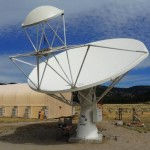
The NRC has begun testing its 15m Dish Verification Antenna (DVA1) a novel prototype for the Square Kilometre Array (SKA). The antenna is optimised for mass production, low cost and high performance – key requirements for SKA antennas. The antenna is an offset Gregorian design developed in collaboration with the US Technology Development Program (US-TDP). A key innovation is the rim supported primary and secondary reflectors that are a carbon fibre composite monocoques design developed at the NRC’s Dominion Radio Astrophysical Observatory, near Penticton. The reflectors are made in a single piece on a precision mold using the vacuum infusion process yielding a precise reflector that can be mass produced with low overall cost.
The primary and secondary have been measured and are within 0.89 mm and 0.2 mm of ideal. Using better molds the NRC team has demonstrated that these errors can be halved yielding reflectors that operate to 20+ GHz and are very stable over temperature, wind and gravity loads compared to conventional approaches.

Testing of the DVA1 is well underway. First light at Ku band on the Sun was achieved at the beginning of August, with holography, pointing and antenna temperature measurements to be completed this fall.
Maunakea Spectroscopic Explorer (MSE)
The Maunakea Spectroscopic Explorer (MSE, formerly ngCFHT) continues to make important progress as it begins a Construction Proposal Phase that will last approximately 3.5 years, and which is led by the newly formed Project Office. Important progress in the last few months includes:
the formation of a Science Team, currently with over 60 members including 10 members from Canada, as well as members from Australia, China, France, Hawaii, India, Japan, mainland USA and elsewhere. August saw the start of science team activities, with White Papers solicited to provide new input to the science development.
the formation of a Science Executive with Contact Scientists from Australia (Andrew Hopkins), Canada (Michael Balogh), France (Nicolas Martin), India (Gajendra Pandey), with other partner countries soon to have representation. This group provides leadership of the science team in collaboration with the Project Scientist (Alan McConnachie).
the ranking of MSE in the top priority bracket for development in the first draft of France’s new 5-year Prospective (roughly equivalent to their LRP). MSE and CFHT remain engaged in the ongoing development of the Prospective.
establishment of much of the basic infrastructure required to operate the Project Office, with headquarters in Waimea.
exploration of permitting issues and options for MSE consistent with the Maunakea Comprehensive Management Plan.
visits and important discussions with our colleagues in China, the Republic of Korea, Taiwan and Japan regarding partnership engagement in the future development of CFHT and MSE, and a planned visit to India this Fall.
Please do not hesitate to contact the following for any questions relating to MSE:
MSE Project Scientist (Alan McConnachie; mcconnachie@mse.cfht.hawaii.edu)
Project Manager (Rick Murowinski; murowinski@mse.cfht.hawaii.edu)
CFHT Executive Director (Doug Simons; simons@cfht.hawaii.edu)
Visit the MSE website at mse.cfht.hawaii.edu for more information and recent news.
NFIRAOS
For the past few months, the NFIRAOS team has been working diligently to engage Canadian industry to progress the NFIRAOS’ opto-mechanical subsystems to final design level in time for the Final Design Review planned for late 2016. Eventually, Canadian industry will construct (fabricate, assemble and test) and deliver these subsystems to NRC-Herzberg for overall system integration before delivery to the TMT Observatory.
The planned out-sourced NFIRAOS subsystems, from 2014 to 2015, are:
Off-Axis Paraboloids (OAP) mirrors and mounts – a total of six units are required.
Beamsplitter (BS) changer with science and engineering beamsplitters, visible light BS and mounts – the science BS separates the infrared science light from the visible wavefront sensor (WFS) light and sends the science light to the client instruments. The visible light BS further separates the WFS light into laser guide star (LGS) path and visible natural WFS (VNW) path for natural guide star (NGS) wavefront sensing. The BS changer switches to the engineering BS to facilitate NFIRAOS assembly and integration.
Instrument selection fold mirror (ISM), mount and rotating mechanism – the ISM reflects the infrared science light and feeds the client instruments, and the rotation mechanism directs light to the top, side and bottom instrument ports of NFIRAOS.
Source simulators assembly – this contains the elements to provide artificial light sources for NGS, LGS and astrometry calibrations. The opto-mechanical components include dithering pinhole mask, deployable fold mirror for NGS sources, carriage for LGS sources, overall structural support and the associated motion control hardware.
LGS path bench assembly – this contains optics, mounts and opto-mechanical mechanisms for the trombone, pickup mirrors, field stops, collimators, six optical barrels which interface with the TMT supplied detector units, overall LGS path structural support and the associated motion control hardware.
VNW bench assembly – this contains optics, mounts and opto-mechanical mechanisms for the packaging fold mirrors, star selection unit, atmospheric dispersion compensator, field stop, fast steering mirrors, switchyard, and NGS optical barrel which interface with the TMT supplied detector unit, Truth wavefront sensor (TWFS) unit, overall VNW path structural support and the associated motion control hardware.
High resolution wavefront sensor (HRWFS) and acquisition camera (ACQ) assembly – this contains optics, mounts and opto-mechanical mechanisms to enable high resolution wavefront sensing, low and high resolution imaging with a common detector over the full NFIRAOS field of view, and the associated motion control hardware. It also contains the overall structural support to mount the HRWFS and ACQ assembly on the side port.
Turbulence generator assembly – this contains optics, mounts and opto-mechanical mechanisms to deploy the turbulence phase screen and transverse between two positions, overall structural support and the associated motion control hardware.
The opto-mechanical subsystems are illustrated in Figure 1. The total value of eight design contracts is $1.7M, ranging from $90K to $300K depending on complexity. The total value of eight construction contracts is $8.5M, ranging from $300K to $3.0M depending on complexity.


Each contract is divided in at least in two phases, design and construction, where the latter phase will be a binding fixed-price offer for construction after successful completion of the subsystem’s final design. A public information meeting was held on Aug 28 to discuss our out-sourcing plan with potential vendors and solicit their feedback. Six companies attended the meeting.
Meerkat Reflectors
NRC Herzberg has a contract with General Dynamics Satcom (GD Satcom) to fabricate two 4 m diameter sub-reflectors and to transfer our technology to them for the fabrication of the remaining sixty two reflectors. The first two reflectors were built in Penticton and delivered before the end of our fiscal year 2013-2014. The reflectors were fabricated in a single piece from vacuum infused carbon fibre. The reflectors both had a surface RMS of 0.1 mm; easily meeting the contract specification of 0.245 mm RMS. The reflectors represent a very light (<100 kg), very simple alternative to the traditional metal multi-piece design (they come off the mold with the correct shape and require no further adjust), and the weight savings allow a further reduction in structural support weight as well as easier handling. The next phase will involve travelling to Johannesburg South Africa to train a local team to fabricate the remaining units.
JCMT Update
By Doug Johnstone, Associate Director JCMT
Countdown! September has arrived and I am now in the last month of my secondment to the Joint Astronomy Centre as Associate Director JCMT. It is hard to believe that two years have passed so very quickly, and of course, there still seems to be a great deal left to accomplish before the end of the month, including this Newsletter piece.
As usual, in this update I will describe recent events at the JCMT, including progress within the JCMT Legacy Surveys, a recap of Semester 14A, and the present status of the JCMT Science Archive. For details on the on-going efforts to transfer the JCMT to an East Asian consortium, please refer to the article in the Summer Solstice edition (June 2014) on the ‘Continuing Evolution of the JCMT’, by Gary Davis, Director of the JAC.
The showcase science programme at the JCMT remains the JCMT Legacy Survey (JLS), covering debris disks, star formation near and far within our Galaxy, nearby Galaxies, and cosmology. Over the last nine months we have managed to increase the completion fraction of the survey, from about 50% to over 75%, despite a dismal winter for sub-millimetre observing on Maunakea. All six of the SCUBA-2 legacy surveys now have a majority of their observations in hand, with the debris disk survey reaching 100% completion in August. Our recent efforts to streamline the observing process and extend observing into the morning hours through limited remote operations have clearly paid off. Of course it also helps when the nightly fault rate for the telescope drops well below 5% of clear-sky time – an impressive threshold for a twenty-seven year old telescope with complex cryogenic and superconducting instrumentation. Kudos and mahalo to the dedicated JAC staff!
We anticipate that JLS observations will be taken throughout much of the Fall as negotiations continue with the East Asian consortium, soon to be known as the East Asian Observatory (EAO), on the smooth transfer of the telescope. Looking further into the future, it is clear that large legacy surveys will be a continuing tradition at the JCMT, and Canadians are being asked to help define these priorities. A number of us will be taking part in a meeting in the UK near the end of September where new and expanded surveys for the JCMT will be developed. Christine Wilson (McMaster) continues to lead the Canadian effort for continued JCMT involvement beyond the NRC Herzberg era.
As Semester 14A nears conclusion, a bittersweet moment for Canada was reached on Thursday, August 13th with the last night of Canadian observing under NRC Herzberg management. Both JAC Director Gary Davis and I were there to mark the occasion, along with UBC graduate student Todd Mackenzie (see attached photo). Todd’s connection to the JCMT started while an undergraduate student. Working as a co-op student at NRC Herzberg with James Di Francesco and me, he helped produce SCUBA Legacy images and catalogues. Now Todd is using SCUBA-2 data as part of his PhD thesis, under the direction of Douglas Scott. Despite having to note the end of an era, I am pleased to announce that Canadian PI’s did extremely well with their share of the flexible telescope time this last semester. Six of the seven top proposals in the Canadian queue obtained at least 95% of their requested observing time. The outlier proposal was, unfortunately, a target of opportunity that simply did not trigger.
In the 2013 Winter Solstice edition I discussed the importance of the JCMT Science Archive (JSA) as part of the legacy of the JCMT. This effort, a collaboration between the JAC and the CADC at NRC Herzberg in Victoria, has been extremely active over the last year. Regular JSA users will have already noticed the simplified interface through which they now search the archive. For those daunted by this change, a helpful primer on searching the JSA is available on the JAC web-page (follow the link from the JCMT landing page at the CADC). Further JSA effort includes a plan for the uniform reduction and cataloguing of all public JCMT SCUBA-2 data residing in the archive. Initial pipeline processing for this effort is now underway and these legacy data products should start to become available through the archive in late Spring 2015. Together with the individual JCMT Legacy Survey team reductions, which are specially designed to pick out science-goal specific features such as point sources or extended structure, these uniformly reduced data products will provide a lasting legacy for the JAC era at the JCMT.
It feels extremely strange to be saying good-bye to the JCMT at this time. This is especially true given that I have spent the last few months working closely with the Director to help secure a long-term future for the JCMT through its transfer to EAO, espousing my admiration and respect for the telescope, its staff, and its community at every opportunity. Just last week I was in Japan at an NAOJ JCMT workshop and next week I will be in the UK to help design future legacy surveys. It is my great hope that despite my formal departure, I will continue to be intimately involved with the JCMT, both as a scientist, making use of its fantastic instrumentation, and as an advocate, providing support and constructive criticism to the new management. Long live the JCMT.

ALMA Update
By Chris Wilson, Canadian ALMA Project Scientist with material from the NRAO newsletters and the ALMA web site
ALMA Current Status
ALMA construction continues to wind down. In late June, 2014, the final ALMA antenna was taken up to the high-level site 5000 meters above sea level. Its arrival completes the complement of 66 ALMA antennas on the Chajnantor Plateau in the Atacama Desert of northern Chile. Images and video of the antenna move can be found at http://www.almaobservatory.org/
The ALMA Phasing Project team, with support from the Extension and Optimization of Capabilities (EOC) Team, the ALMA Department of Engineering, and the ALMA Department of Computing, integrated the new hydrogen maser into the ALMA system. This is an important milestone toward incorporating ALMA as a Very Long Baseline Interferometry array element. Tests have shown the maser performance is excellent, and it has replaced the rubidium clock as the ALMA time standard.
The August weather at Chajnantor was very good, as is usual for the austral winter, and the high frequency campaign made good use of the resulting excellent high frequency transparency. Multiple objectives were met, including the imaging of Uranus with 29 array elements at ALMA Band 10 (350 microns, 810 GHz) by the EOC team. The EOC team also demonstrated the transfer of phase information from lower frequencies, where calibrators are brighter and more densely distributed, to higher frequencies. Simultaneous sub-arraying within the main 12 m array was demonstrated for the first time, a key goal for achieving simultaneous EOC and Early Science operations.
On September 1, 2014, the EOC Team started the Long Baseline Campaign and will continue commissioning-type observations through the end of November. This critical campaign is essential for Cycle 3 proposed capabilities and will test the calibration and imaging characteristics of ALMA out to baselines of at least 10 km. All ALMA Early Science Observations (both Cycle 2 and carryover Cycle 1 programs) have been halted until the end of the campaign. This break in Early Science observing is needed because of the time required to move antennas out to the largest configurations and the fact that once the antennas are spread out to 5-10 km, the antennas remaining nearer the center of the array are not sufficient to populate any of the Cycle 2 configurations.
ALMA Cycle 2 progress
Results of the Cycle 2 proposal review process were sent to the PI on April 9, 2014 and the full list was released May 2, 2014. A full listing of the 353 highest priority proposals is available here. More recently, a detailed report on the outcome of the ALMA Early Science Cycle 2 Proposal Review Process has become available. The report describes the proposal review process, proposal statistics and regional distributions as well as the proposal distribution across science categories and receiver bands. The report can be downloaded as a pdf document here.
Cycle 2 observing began in a higher resolution configuration, with a longest baseline of 650 m, and is planned to cycle into larger configurations as the austral winter progresses. As noted above, all ALMA Early Science Observations have been halted until the end of the long baseline campaign. Early Science observations are scheduled to resume in December 2014 in array configuration C34-3. Observations in array configuration C34-1 are expected to begin in January 2015.
PIs and Co-Investigators can consult the Project Tracker for information on the execution of an accepted project. PIs can also modify their user profile at the Science Portal to receive e-mail notifications whenever a component of a project is first observed, fully observed, or successfully processed.
Archival and Science Verification Data
All the data from Cycle 0 Early Science projects have been delivered. The data are made publicly available via the ALMA archive as the one-year proprietary period expires. A total of 109 of the 116 Cycle 0 projects are available in the ALMA Science Archive; only a few projects are still within their proprietary period. Twenty-five of the 69 North American high priority Cycle 1 projects have been fully delivered and two-thirds of the highest-ranked NA Cycle 1 projects have seen deliveries of some data.
Data for two new ALMA Science Verification targets were released on September 7, 2014. The targets are (1) the evolved star VY Cma observed in water maser lines in Bands 7 (~850 microns) and 9 (~450 microns) and demonstrating ALMA capabilities on 1-3 km baselines and (2) Comet Lemmon observed in the HCN line in Band 6 (~1.1 mm) and demonstrating Doppler tracking of ephemeris targets. All Science Verification targets are listed on the Science Verification web page and the data sets are available through the ALMA Science Portal.
ALMA software news
CASA release 4.2.2 is now available from the CASA homepage: http://casa.nrao.edu/.This is a patch release of CASA 4.2.0/4.2.1 to introduce SIGMA and WEIGHT columns defined according to channel width and integration time. The patch also adds the plotms capability to export iterated plots in multiple files. A detailed description of the CASA visibility weighting scheme can be found at http://casa.nrao.edu/Memos/CASA-data-weights.pdf. CASA, the Common Astronomy Software Applications (CASA) package, is being developed by NRAO, ESO, and NAOJ and is used for the offline reduction and analysis of both ALMA and VLA data. CASA is fully scriptable. Full support is provided for ALMA and VLA but almost any data that can be written in uvfits format can be imported and reduced in CASA (for example, CARMA, SMA, ATCA).
ALMA has begun routine data reduction using the automated pipeline. The pipeline is now the principle means of data calibration and flagging for PI projects at ALMA. Previously, all ALMA data were reduced manually by ALMA’s team of scientists around the globe. For example, for North American projects the data have been reduced by staff scientists at the North American ALMA Science Center (NAASC) at NRAO Headquarters in Charlottesville and in Victoria, Canada, and at the Joint ALMA Observatory in Santiago, Chile. This transition to pipeline processing comes at a critical time when the ALMA data rate is high and continuing to grow. The pipeline is essential to allowing the ALMA observatory to cope with the current and anticipated future data rates. The pipeline has been developed by a dedicated team of engineers and scientists (including, from 2002-2010, C. Wilson as the sub-system scientist) with the aim of being able to handle the majority of ALMA observing projects. Some non-standard modes will continue to need manual reduction. The pipeline currently handles flagging and calibration while the imaging step continues to be done manually. The imaging portion of the pipeline is still under development and testing.
ALMA Meetings
There are two workshops and one major ALMA meeting planned in the next year:
“Revolution in Astronomy with ALMA: The Third Year” will be held from December 8-11, 2014, in Tokyo, Japan. Registration is still open and the deadline for abstracts for posters and registration is October 15, 2014. The web site is http://www.almasc2014.jp/.
A NAASC workshop on “The Filamentary Structure in Molecular Clouds” is being held 10-11 October 2014 in Charlottesville Virginia. Registration is now closed but there is a waiting list. The conference web site is https://science.nrao.edu/science/meetings/2014/filamentary-structure/.
“Dissecting Galaxies Near and Far” is the subject of a workshop to be held March 23-27, 2015 in Santiago, Chile. Preliminary information is available on the conference web site, http://www.eso.org/sci/meetings/2015/Galaxies2015.html.
Information
A good source for monthly updates on the ALMA project is the electronic NRAO newsletterhttp://science.nrao.edu/enews/. And don’t forget the ALMA observatory web site http://www.almaobservatory.org/ which contains wide range of information about the observatory, including details about science and technology, infrastructure, and geographical location.
An email list has been created for Canadian astronomers interested in ALMA. This moderated list will periodically send out updates on ALMA’s status, news of software releases, notices of upcoming ALMA science meetings and workshops, etc., which would be of interest to Canadian astronomers. Those who wish to be subscribe to the alma-users list are encouraged to visit the web page http://lists.astrosci.ca/mailman/listinfo/alma-users/ or send an email to Gerald.Schieven(at)nrc-cnrc.gc.ca.
Herschel-HIFI news
From Sylvie Beaulieu, Herschel-HIFI Instrument Support Scientist
Herschel feature story
The current (September 2014) Herschel Feature Story on the Herschel website is Young Sun’s Violent History Solves Meteorite Mystery.
Continued support for using Herschel Science Archive data
On the 29th of October 2013, the last proprietary science observation was released into public domain through the Herschel Science Archive. This represents an excellent opportunity for additional astronomical discoveries for the larger Canadian astronomical community. The University of Waterloo Herschel-HIFI Group remains dedicated to help you achieve your scientific goals.

Herschel Interactive Processing Environment (HIPE)
HIPE 12.1 is the current released version. Please visit What’s New in HIPE for the latest changes in this release. The task hebCorrection can help mitigate the electric standing waves in HEB (bands 6 and 7). Detailed instructions on how to use the task are in the HIFI Data Reduction Guide. Additional information can be found in the HIFI Instrument and Calibration webpage, under Outstanding Calibration Issues.
Warning: a major bug in gain fitting was discovered in the doDeconvolution task. When running the task, this feature should not be used. A revamp of the task (and its documentation) is underway for HIPE 13. Stay tune…
At last! New HIFI beam release
The HIFI team has released a revised version of their beam, involving in particular updates to the coupling efficiencies and Half-Power-Beam-Width, and the delivery of detailed 2D beam models in each HIFI band. A new section of the HIFI calibration page has been created to this effect and Users are invited to carefully read the release notes prepared with these updates. In particular, we want to emphasise that the newly derived aperture and main beam efficiencies have dropped by up to 10% and 20% respectively, leading to equivalent increase of the converted fluxes or main beam temperatures. If you need any additional information in that respect please contact the Helpdesk.
Conferences, workshops and webinars related to Herschel
“Universe Explored by Herschel” conference proceedings now available online.
NHSC Herschel Workshop: “The Hitchhiker’s Guide to Extracting SEDs and Spectra from the Herschel Science Archive”, 6-10 October 2014, Pasadena, California.
Star Formation Across Space and Time, ESA/ESTEC Noordwijk, 10-14 November 2014
Dissertation: The X-ray View of Galaxies in Compact Groups and the Coma Cluster Infall Region
By Tyler D. Desjardins
Thesis defended on July 30th 2014, University of Western Ontario
Thesis advisor: Sarah C. Gallagher
Abstract
In this thesis, we have explored what information may be gleaned from X-ray observations of galaxies in dense environments. We use X-ray observations from XMM-Newton and the Chandra X-ray Observatory, and multi-wavelength ancillary data, to investigate the X-ray emission of galaxies. First, we study the distribution and properties of the intragroup diffuse X-ray emission in compact groups (CGs) of galaxies. From a sample of 19 CGs, we find the morphology of hot gas in low-mass groups is varied, and most systems have hot gas (if any) associated with only individual members. The galaxy-linked hot gas is coupled with high star formation rates (SFRs), while only CGs with high baryonic masses have substantial hot gas linked to the group environment. It is high-mass CGs that also agree well with the observed scaling relations between diffuse X-ray luminosity (LX), gas temperature, and velocity dispersion predicted and observed in galaxy clusters, indicating that the hot gas in only massive CGs is virialized. We also investigate the relations between LX, SFR, and stellar mass from individual members of CGs and the infall region of the nearby Coma galaxy cluster, which is the only environment that has a mid-infrared galaxy color distribution similar to CGs. The Coma galaxies agree with the scaling relations between LX, SFR, and stellar mass from the literature within uncertainties, while the CG members often show an X-ray excess. We also used our multi-wavelength observations to identify active galaxies in the Coma infall sample and find that the fraction of active galaxies is similar to the CG environment. From our observations of the diffuse X-ray emission in CGs, we find it unlikely that the intragroup hot gas is responsible for the rapid transformation of galaxies from star-forming to quiescent. While the fraction of nuclear activity in Coma infall and CG galaxies is similar, which may reflect the influence of multi-galaxy gravitational interactions, the X-ray emission from individual galaxies in the two environments is also markedly different.
Dissertation: Spectroscopic survey and study of the physical properties of white dwarf stars within 40 pc of the Sun
By Marie-Michèle Limoges
Thesis defended on August 18th 2014, Département de physique, université de Montréal
Thesis advisor: Pierre Bergeron (U de Montréal), Co-directeur/co-advisor: Sébastien Lépine (Georgia State U)
Abstract
White dwarf stars represent the endpoint of stellar evolution for 97% of stars in the Galaxy. Our own Sun, in particular, will lose its external gas layers in about 5 billion years, and end up as an Earth-sized white dwarf. The study of their global properties (temperature distribution, mass distribution, luminosity function, etc.) requires statistically complete samples, free from any selection bias, and thus the best strategy to adopt when surveying these low-luminosity objects is to restrict the search to a given volume such as the immediate vicinity of the Sun. However, the current census of white dwarfs in the solar neighborhood suffers from significant statistical biases, since the most representative sample of the local white dwarf population, i.e. the stars within a sphere with a radius of 20 pc from the Sun (∼ 65 light-years), contains only ∼ 130 objects, and is thus dominated by large uncertainties due to small-number statistics. In order to perform a statistical analysis of the local white dwarf population which is more statistically significant, we present a study aimed at obtaining a complete sample of white dwarfs in the solar neighborhood within 40 pc of the Sun, thus increasing the sampled volume by a factor of 8.
To identify every white dwarf within 40 pc of the Sun, we rely on SUPERBLINK, a large catalog containing proper motions and photometric information for over 2 million stars. Our approach is based on reduced proper motion diagrams, which are efficient at separating white dwarfs from other stellar populations. The distances for all white dwarf candidates in the northern hemisphere are determined from theoretical color-magnitude relations, in order to identify the stars that lie within 40 pc of the Sun. The spectral confirmation of the resulting ∼ 1100 candidates required 15 observing runs with 3 large telescopes at Kitt Peak, Arizona, as well as ∼ 60 hours of allocated time on the 8-m telescopes of Gemini North and South Observatories. From these spectroscopic observations, we identified 322 new white dwarf stars, among which 173 lie within 40 pc the Sun, thus increasing the current census of white dwarfs in this volume of space by 40%. Among the new white dwarf identifications, 4 could even belong to the 20 pc sample. We also show that our method is efficient at recovering white dwarfs in the densely populated area of the Galactic plane.
We then present a spectroscopic and photometric analysis of our sample with state-of-the- art model atmospheres in order to determine their physical properties, in particular the effective temperature, surface gravity, and chemical composition of each star. Our statistical analysis of these properties — based on a sample almost three times larger than the 20 pc sample—reveals that we are successfully uncovering the most massive and thus less luminous stars of this population, which are often missing in most surveys reported in the literature. We also identify a significant number of very cool and thus potentially old white dwarfs, which are useful to sample the cool end of the luminosity function used to constrain the age of the Galactic disk. Finally, we report the discovery of several objects of astrophysical interest, including two new ZZ Ceti variable stars, several magnetic white dwarfs, and a few unresolved double degenerate binaries.
Dissertation: Chemical Abundances of Local Group Globular Clusters
By Charli Sakari
Thesis defended on July 31st 2014; University of Victoria
Thesis advisor: Kim Venn
Abstract
Detailed chemical abundances of globular clusters in the Milky Way and M31 (the Andromeda Galaxy) are presented based on analyses of high resolution spectra. The unusual Milky Way cluster Palomar 1 (Pal 1) is studied through spectra of individual red giant branch stars; these abundances show that Pal 1 is not a classical globular cluster, and may have been accreted from a dwarf satellite of the Milky Way. The Milky Way globular clusters 47 Tuc, M3, M13, NGC 7006, and M15 are studied through their integrated light (i.e. a single spectrum is obtained for each cluster) in order to test high resolution integrated light analyses. The integrated abundances from these clusters reproduce the average abundances from individual stellar analyses for elements that do not vary within a cluster (e.g. Fe, Ca, and Ni). For elements that do vary within the clusters (e.g. Na and Mg) the integrated abundances fall within the observed ranges from individual stars. Certain abundance ratios are found to be extremely sensitive to uncertainties in the underlying stellar populations, such as input models, empirical relations to determine atmospheric parameters, interloping field stars, etc., while others (such as [Ca I/Fe I]) are largely insensitive to these effects. With these constraints on the accuracy and precision of high resolution integrated light analyses, detailed abundances are obtained for seven clusters in the outer halo of M31 that were recently discovered in the Pan-Andromeda Archaeological Survey (PAndAS) and are likely to have originated in dwarf galaxy satellites. Three clusters are relatively metal rich ([Fe/H] > -1.5) for their locations in the outer halo; their chemical abundances suggest that they likely originated in one or more fairly massive dwarf satellites. The other four are more metal-poor, and may have originated in less massive dwarf satellites. These results indicate that the Milky Way and M31 have both experienced some amount of accretion from dwarf satellites, though M31 may have had a more active accretion history.
Madawaska Highlands Observatory Corp.
By Frank Roy, founder and CEO
Company Expects to Complete Financing in 2014
The company is expecting to close its financing for the facility shortly. As part of that effort, the company has launched an Initial Crowd Offering (ICO) on Optimized Capital Markets listing service.

The offering can be viewed on the Optimize Capital Markets OCMX website.
Optimize Capital Markets, our exclusive financial agent, is a Bay Street firm, leading the next generation of Investment Banking Firms through its Institutional Corporate Finance Team coupled with its Institutional Crowdfunding Marketplace. Optimize Capital Markets launched its operations in September of 2009 out of Toronto but has since expanded its operations to include Quebec, Alberta, and British Columbia. Optimize Capital Markets and its marketplace, the OCMX, connects institutional and accredited investors directly with businesses seeking financing transactions and other investment opportunities.
The company is very excited about the ICO. Reaction from investors has been extremely positive and very encouraging.
Science Partner
The company is interested in a single science partner. Up to 100 hours per year (about 10% of the available science time) would be made available to our partner. The company is looking for long term commitments. The Wide-Field-Telescope is expected to become operational Q4/2017. Partners from anywhere in the world will be considered. The partner may also be a consortium. Please contact us for more information.
Documents and eNewsletter
You can subscribe to our eNewsletter
Distances from Major Universities in Southern Canada and the North-East USA
The proximity of 13 Canadian Universities within 600 Km is very advantageous to these institutions in terms of easy accessibility and travel convenience. This represents 55% of Canadian Universities which are members of ACURA. Queen’s and Trent Universities are a two hour drive, a day’s return trip. Four Universities [Toronto, York, McGill and Montréal] are within 3.5 hours travel. McMaster and Waterloo are within 4.5 hours and Western and Sherbrooke are within 6 hours. Université Laval in Québec City is seven hours away.
The Universities of Ottawa and Carleton are within 120 Km. They currently offer introductory courses in astronomy and astrophysics. We expect that with the proximity of a nearby major astronomical observatory they may want to offer more advanced courses and degrees.
The facility is also within 8 hours of twenty-eight US universities. We expect strong interest from these institutions due to their proximity.


Comments